Incidence of Rheumatoid Arthritis in District Narowal, Pakistan
1School of Basic Medical Sciences, Fujian Medical University, Fuzhou 350108, China.
2Department of Zoology, Lahore College for Women University, Lahore 54000, Pakistan.
3Pakistan Science Mission (PSM), Noor Kot 51770, Pakistan.
4The School of Life Sciences, Fujian Agriculture and Forestry University, Fuzhou 350002, China.
5Department of Anatomy and Histology, University of Veterinary and Animal Sciences, Lahore 54000, Pakistan.
6Department of Zoology, University of Poonch, Rawalakot 12350, Azad Kashmir, Pakistan.
7Department of Zoology, PMAS Arid Agriculture University, Rawalpindi 46000, Pakistan.
*Corresponding author:
Asfa Ashraf;Email:
sundausnaeem@yahoo.comReceived: 15.Mar.2016; Accepted: 17.Aug.2016
Views 3149
Abstract
Rheumatoid arthritis is a disease of modern civilization and attacking people in every part of the world and people of every field are being affected. The data about the incidence of rheumatoid arthritis of sixty patients was collected by interviewing them in different hospitals of district Narowal. The relative occurrence and incidence of rheumatoid arthritis in different age groups was determined. The analysis shows the prevalence of rheumatoid arthritis was more in males (55%, n=33/60) compared to females (45%, n=27/60). Rheumatoid arthritis was more prevalent in age group of 41-50 years (32%, n=19/60) and less prevalent in age group of 61-70 years (3%, n=2/60). In our sample population the prevalence of rheumatoid arthritis by age group of 11-20, 21-30, 31-40, 41-50, 51-60 and 61-70 was 10, 15, 28, 32, 12 and 3% respectively. In the developing countries the incidence of rheumatic diseases is frequently unidentified so there is requirement of investigations to know the exact rate and risk factor of this overwhelming disease.
Keywords
Incidence, rheumatoid arthritis, age groups, population.
Citation
Ashraf, A., Iqbal, M.N., Iqbal, I., Yunus, F.N., Alam, S., Muhammad, A., Farooq, M.U., Irfan, M., 2016. Incidence of Rheumatoid Arthritis in District Narowal, Pakistan. PSM Biol. Res., 01(2): 49-52.
Introduction
The term rheumatoid arthritis was originated by A. B. Garrad, a French medical student in 1858 (Schiff, 1997). Rheumatoid arthritis is a systemic auto-immune disorder affecting people across the globe with varying severity (Mathers and Pfleger, 2006). Thus rheumatoid arthritis is a type of joint inflammation that resembled rheumatic fever (Sequeira, 2006).
Rheumatoid arthritis is enfeebling disease with significant effect on patients’ lives, on their families and humanity as a whole. The world frequency of rheumatoid arthritisis is approximately 0.3-1.2 percent. The syndrome is present in all populations that have been calculated, with the feasible immunity of rural African populations. The maximum occurrence rates have had it in American Indian tribes, Alaskan Indians and the lowest in African, Asian countries. Epidemiological studies in methodological differences get in the way comparison between populations, and there is no information about the same determinants of the disease in all the groups studied. From an monetary point of view, the charge of the therapeutic and surgical treatment for rheumatoid arthritis and the income gone because of disability caused by the disease include up to billions of dollars once a year (Silman and Hochberg, 2001). Rheumatoid arthritis has a consistent mortality ratio >2, which is attributable generally to enlarged cardiovascular mortality, and the results include that avoidance of cardiovascular disease becomes the aim of rheumatoid arthritis treatment (Cleland and James, 2002). While rheumatoid arthritis is in the middle of the foremost situation causing disability, little about this devastating syndrome is in reality well-known (Helmick et al., 2008).
It is difficult to diagnose the disorder because of the lack of a discrete scientific symbol of the disease even though, RA has a lot of symptoms and several related circumstances (Mathers and Pfleger, 2006). While RA is being scientifically assumed, immunological descriptions are obligatory, such as rheumatoid factor (RF, a specific antibody). A harmful rheumatoid factor does not imperative RA; moderately, the arthritis is called seronegative. During the first year of illness, rheumatoid factor is frequently negative. Sequeira. (2006) reported that 80 percent of patients ultimately switch to seropositive category. Sjogren’s syndrome is also responsible for the Rheumatoid factor and in just about 10 percent of the vigorous inhabitants; thus the investigation is not very precise. Also, numerous additional blood tests are frequently completed to allocate for other causes of arthritis, such as lupus erythematous. The erythrocyte sedimentation rate (ESR), C-reactive protein, complete blood count, renal function, liver enzymes and other immunological tests (e.g. antinuclear antibody/ANA) are all performed at this stage. Ferritin can reveal hemochromatosis, which can mimic RA (Sequeira, 2006).
Information about the burden of disease provided by the observation of the frequency of rheumatic disease and recommended a requirement for terms of physical condition examine. There is a need to determine the incidence of rheumatoid arthritis, as it may facilitate to illuminate the etiology of the disorder, thinking that dissimilar rates may be present in populations with diverse hereditary and ecological backgrounds (Carmona et al., 2002). The description about the incidence of rheumatoid arthritis in Pakistan is not known properly, and only the minority studies have been carried out about the epidemiology of common rheumatic disorder. The aim of the current study was to determine the incidence of rheumatoid arthritis in a delegate population of Narowal district.
Materials and Methods
The incidence of rheumatoid arthritis was observed in 100 samples of patients. The data of patients suffering from rheumatoid arthritis was collected from people visiting hospitals of Narowal (Pakistan). A questionnaire was developed to collect patient history. The questionnaire includes information regarding family history of patients and information relevant to various risk factors associated with the disease. The patients were diagnosed using American College of Rheumatology / European League against Rheumatism Rheumatoid Arthritis Classification Criteria. Data obtained was tabulated using Microsoft Excel (MS Excel 2010, Microsoft Corporation). SPSS version 16.0 statistical software (SPSS, Chicago, IL) were used for statistical analysis.
Results and Discussion
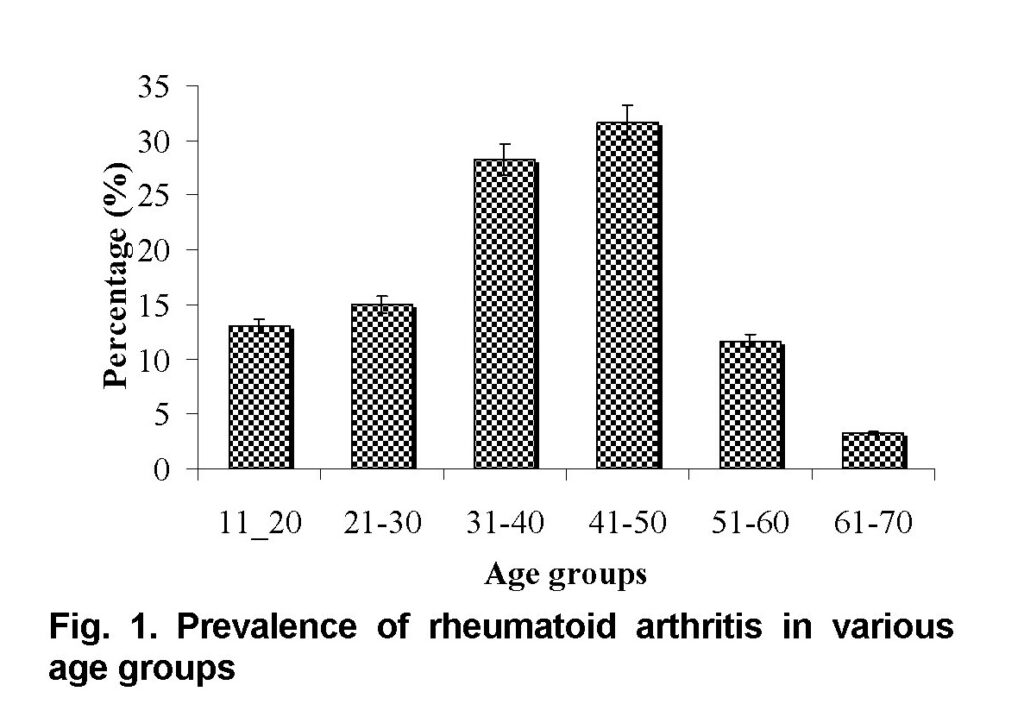
The current study was designed to find out the occurrence of rheumatoid arthritis (RA) in different age groups among hospital population. The data regarding incidence of rheumatoid arthritis in relation to age groups is presented in Figure 1. Sixty patients were studied in which there had been found a higher incidence of rheumatoid arthritis among age group of 41-50 years. Present study revealed that rheumatoid arthritis affects the people of all ages. In addition, the disease affects all races with equal probability.
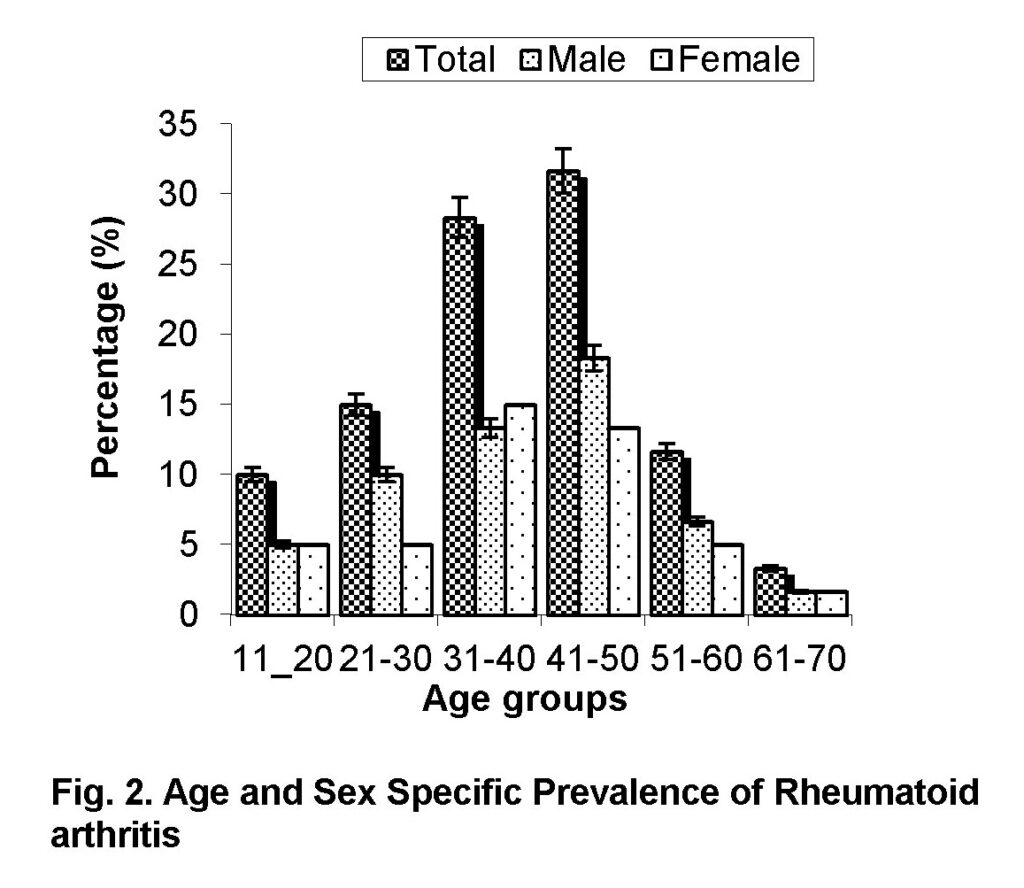
The data regarding age and sex wise prevalence of RA is presented in Figure 2. The rate of RA was 10 percent in the age group of 11-20 years among which 50 percent were males and 50 percent were females,15 percent in the age group of 21-30 years among which 66.66 percent were males and 33.33 percent were females, 28.33 percent in the age group of31-40 years among which 47.05 percent were males and 52.94 percent were females, 31.66 percent in the age group of 41-50 years among which 57.89 percent were males and 42.10 percent were females, 11.66 percent in the age group of 51-60 years among which 57.14 percent were males and 42.85 percent were females and 3.33 percent in the age group of 61-70 years among which 50 percent were males and 50 percent were females.
Shamim et al. (2015) reported that among 320 patients, eighty five (26.9%) were diagnosed as rheumatoid arthritis, 70.5% were females and 26.3% were males in Karachi Pakistan. Alam et al. (2011) reported that amongst 4900 patients with rheumatic symptoms, 633(12.9%) patients were diagnosed cases of RA. Out of 633 patients, 509 were females and 124 were males, making the ratio 4:1(F: M). Among all 17.48% of females and 6.45% of males belonged to the age group between 16-29 years, with 48.52% of females and 39.5% of males being between the ages of 30-49 years. Whereas, 33.9% of females and 54.0% of males presented between 50-75 years of age group. Prevalence of RA in Pakistan was found to be 0.14% among which 0.0-1.08% were male and 0.0-2.86% female (Farooqi and Gibson, 1998; Hameed et al., 1995; Hameed and Gibson, 1997).
Goldman. (2004) reported that rheumatoid arthritis affects a probable 0.5 percent to 1 percent of the population worldwide. Onset usually occurs between the ages of 30 and 50. The disease affects 2 to 3 times as many women as men until the age of 65 years, after which point the ratio of women and men affected is approximately the same. The frequency of RA in women suggests that heredity and hormones may play some role in the cause of RA. According to CDC (Center for disease control) 28.3 million women and 18.2 million men report doctor-diagnosed arthritis (all types) (Carol and Eustice, 2007). Regarding higher prevalence of diseases in women, Iqbal et al. (2016) reported higher prevalence of angina pectoris in female population in district Narowal. Iqbal et al. (2015) documented the role of risk factors like smoking, family history, and obesity towards the development of disorders like hernia in human population in district Narowal.
Unusual occurrence rates of RA depend upon sex, lifestyle, and age and it is not evenly widespread across the world. Shamim et al. (2015) reported 7.9% patients with positive family history, 90.2% were chronic sufferers and 67.1% patients belonged to highly literate class. Considering the current clinical status 9.5 percent had persistent symptoms of pain in joints, swelling and stiffness of joints which increases in the morning as well as in cold weather. In general global pervasiveness of RA is just about 0.5% to 1%, but it is on the way out in the United States (Aletaha et al., 2010). The frequency of rheumatoid arthritis has declined to 1.3 million Americans, from 2.1 million in 1990 (Reinberg, 2008). The estimated prevalence of RA in the grown Spanish inhabitants was 0.5%. The prevalence of RA was 0.8 percent in women and 0.2 percent in men (Carmona et al., 2002). But the frequency of RA in China is about 0.2-0.3 percent of the inhabitants in opposition to frequency of 0.8 percent in the western world (Silman and Hochberg, 2001).
The normally low frequency of RA in the third world countries has been attributed to non-recognition of diseases, the characteristics and statistics of human population such as the compact endurance of women with or without RA or the non-attendance of ecological contributory factors (Farooqi and Gibson, 1998).
Conclusion and Recommendations
Occurrence of RA is near to the ground in the representative population of Narowal. It equally affects male and female of all races and of all ages. Disease occurs more frequently between the ages of 40 to 50. Early diagnosis of the disease and proper provision of medication is the need of the hour. Epidemiological studies should be planed occasionally to check the occurrence rate of such chronic and disabling diseases. Biologic agents (drugs such as etanercept, infliximab which target specific cytokines that play a role in inflammation) are used to help slow or stop the progression of joint damage and erosions from RA.
Acknowledgement
The authors are highly thankful to Pakistan Science Mission (PSM) for their technical support during this research work.
Conflict of Interest
There is no conflict of interest.
References
Alam, S.M., Kidwai, A.A., Jafri, S.R., Qureshi, B.M., Sami, A., Qureshi, H.H., Mirza, H., 2011. Epidemiology of rheumatoid arthritis in a tertiary care unit, Karachi, Pakistan. J. Pak. Med. Assoc.,61(2): 123-6.
Aletaha, D., Neogi, T., Silman, A.J, et al., 2010 rheumatoid arthritis classification criteria: an American College of Rheumatology/European League Against Rheumatism collaborative initiative. Arthritis Rheum., 62(9): 2569-2581.
Carmona, L., Villaverde, V., Hernandez_Garcia, C., Ballina, J., Gabriel, R., Laffon, A., 2002. The prevalence of rheumatoid arthritis in the general population of Spain. J. British Society for Rheumatology., 41(1): 88-95.
Cleland, L., James, M.J., 2002. Rheumatoid arthritis.The Med. J. of Australia., 176(11): 119-120.
Carol., Eustice, R., 2007. 10 things you should know about rheumatoid arthritis. J. About. Com. 19th April.
Farooqi, A., Gibson,T., 1998. Prevalence of the major rheumatic disorders in the adult population of North Pakistan. Rheumatology. Oxford University Press., 5(37): 491-495.
Goldman, L., 2004. Cecil Textbook of Medicine. 22nd edition. Pa: WB Saunders. Philadelphia. 1644-1646.
Hameed, K., Gibson, T., Kadir, M., Sultana, S., Fatima, Z. and Syed, A., 1995. The Prevalence of rheumatoidarthritis inaffluent and poor urban communities of Pakistan. Br. J. Rheumotol., 34(3): 252-256.
Hameed, K., Gibson, T., 1997. A comparison of the prevalence of rheumatoid arthritis and other rheumatic diseases amongst Pakistanis living in England and Pakistan. Br. J. Rheumotol., 36(7):781-5.
Helmick, C., Felson, D., Lawrence, R., Gabriel, S., Hirsch, R., Kwoh, C., Stone, J., 2008. Estimates of the prevalence of arthritis and other rheumatic conditions in the United States. PartI. Arthritis And Rheumatism, 58(1): 15-25.
Iqbal, M.N., Akhter, S., Irfan , M., 2015. Prevalence of hernia in relation to various risk factors in Narowal, Pakistan. Sci Lett., 3(1):29-32.
Iqbal, M.N., Ashraf, A., Yunus, F.N ., Muhammad, A., Alam, S., Xiao, S., Ali, S., Irfan, M., 2016. Prevalence of Angina Pectoris in relation to various risk factors. PSM Biol. Res., 01(1): 06-10.
Mathers, D. S. C., Pfleger, B., 2006. The global burden of rheumatoid arthritis in the year 2000. Criterion, 1, 2.
Reinberg, S., 2008. 46 million Americans suffer from arthritis. U. S. News. 13th November.
Shamim, R., Jan, M.D., Zafar, U., 2015. Prevalence of rheumatoid arthritis in population with arthralgia presenting to a tertiary care hospital. J. Pak. Med. Assoc., 65: 1202; 2015.
Silman, A., Hochberg, M.C., 2001. Epidemiology of Rheumatic disease. 2nd edition. New York: Oxford University press.
Sequeira, R., 2006. Rheumatoid arthritis. Pangaea Medicine,20(1): 34-37. Schiff, M., 1997. Emerging treatment for rheumatoid arthritis. Am. J. Med., 1029(1): 11-15.