Effect of Post-emergence Herbicides to Control Broad-leaved Weeds in Wheat under Rainfed Conditions
1Department of Agronomy, PMAS ARID Agriculture, University Rawalpindi, Pakistan.
2The School of Life Sciences, Fujian Agriculture and Forestry University, Fuzhou 350002, China.
3Pakistan Science Mission (PSM), Noor Kot 51770, Pakistan.
4Department of Zoology, Lahore College for Women University, Lahore, 54000, Pakistan.
5National Agriculture Research Center (NARC) Islamabad, Pakistan.
*Corresponding author:
Muhammad Asad;Email:
muhammadasad753@gmail.comReceived: 10.Nov.2015, Accepted: 20.Feb.2016
Views 4423
Abstract
Weeds have an essential economic impact on crops. By competing for resources such as nutrients, water and light, wheat yield decreased approximately ten percent each year. Deprived of weed control, crop yields can be expressively a bridged. Commonly shown that weeds show slow harvest and increase combine repair costs. Some herbicides afford excellent control on broadleaf weed with small or no damage of wheat. Injury varies with variety, growth stage and herbicide. Until on the basis of sensitivity of herbicide there is no any type of research has been conducted on many of the varieties planted. Exclusively this review inspects the field problems of weeds from the chemical point of view. Buctril Super 60EC, Lihua, Ally max and Wheat Star have been studied in populations of herbicide selection and have therefore been selected as vital for this review. A lot of herbicides suggested to control of broadleaf weeds in wheat are Affinity Broad Spec (tribenuron + thifen sulfuron), Buctril super 60 % EC, Logoran Extra, Starane-M, Agility SG (Metsulfuron dicamba + Tribenuron + Thifensulfuron), Ally XP (metsulfuron), 2,4-D, Banvel (dicamba), Bristle 69 EW, Amber (triasulfuron), Curtail (2,4-D + clopyralid), Harmony Puma super 69EW, Topik 15WP, Safener15WP, Certain 80WD and Tremor 24EC. On the basis of exceptional control of broadleaf weeds estimated Bromoxynil, Pyrasulfotoleis and another tool to control ALS-inhibitor resistant weeds. Current studies were started to find out the most effective and economical herbicide and their rates to control broad leaved weeds in wheat.
Keywords
Broad-leaved weeds, Post-Emergence Herbicides, Rainfed.
Citation
Asad, M., Iqbal, M.N., Ashraf, A., Mahmood, Z., Arshad, A., Raza, U., Kashif, M., 2016. Effect of Post-emergence Herbicides to Control Broad-leaved Weeds in Wheat Under Rainfed Conditions. PSM Biol. Res., 01(1): 16-21.
Introduction
Because of comparable morphology and growth pattern, monocot weeds offer more serious rivalry. There are numerous variables for this decrease, for example, inappropriate seed rate and sowing techniques, late sowing, lacking plant populace, deficit soils with nutrient and irrigational water unavailable at basic phases of crop yield, weed rivalry bringing about the diminishment in the yield of wheat (Guttieri et al., 2001). Depending on intensity of weeds reduction in crop yield from 9.5 to 16.05 percent occur (Jalis and Muhammad 1980). Commonly weeds represent expensive and limiting factors in crop production, posing threshing and harvesting problems (Noorka et al., 2013). One of the most critical problems is weed in crops because they contest with crop plants for moisture, light, space and nutrients (Khan et al., 2001).
To achieve the food demand in the world, As compared to other food crops wheat grades best consumed and grown in many countries of the world (Noorka et al., 2013). Wheat is the important food grain of Pakistan and being the essential regimen and inhabits a dominant spot in agricultural programs. Contribution of wheat is about 2.2 % to GDP and its value for value added is 10.3 % in agriculture. Area of wheat sowing increased more than 4.4 % as compared to last year i.e. 8660 to 9039 thousand hectares. Against the target (FCA) received during 2013-14 which was 25 million tons i.e. wheat production stood at 25.3 million tons during 2013-14, which is 1.2% extra than the required limit, compared to last year’s production an encouraging growth of 4.4 percent witnessed over production of 24.2 million tons. Generally rise in area sown is ascribed to the striking rates of market and available area because of early maturity of crop. Increase in production is because of increase in cultivated area and rainfall at steady pauses and favorable meteorological conditions appropriate for wheat grains (Anonymous, 2014).
In spite of the use of amended cultural practices and expensive inputs, decrease in average production occurs in wheat. There are many motives for this decrease in yield, among them one of the less noticeable and utmost serious, is weed competition. Weeds contest with other crop plants for light, moisture, nutrients, space, and other growth aspects, which not only decrease yield but also worsen of farm produce quality and thus decrease its marketplace value (Qureshi et al., 2002). The escalation in the straw yield as a result of application of water extracts may be the effect of well weed control or result of allelopathic chemicals present in the allelopathic crop water extracts applied or because of availability of nutrients existing in soil, when weed infestation reduced in the plots where weed control treatments application occur, weed wheat competition for the resources ultimately decreases which cause better growth of crop plants and result in an increase in crop yield components. These results verified the observations of (Reeves, 2006) that weeds infestation decreased dry matter production in wheat. Similarly (Anwar et al., 2003) and (Marwat et al., 2005) reported the crop water extracts influenced the wheat yield components. Weeds are one of the major factors which harmfully affect the wheat crop yield. Competition occurs between them for growth, nutrients, light, moisture and many others. They decrease yields, lesser the superiority of the crop and raise the rate of harvesting, cleaning and threshing (Abbas et al., 2009). Therefore weed control is significant constituent of managing performs that was used to escalation crop growth. Possession in interpretation the influence of aggressive weeds on atmosphere, article 8(h) of the Agreement on Biological Diversity (CBD) contracted by 161 countries at the Earth Summit in 1992 which impulses the revelries to “avert the overview of or eliminate those unfamiliar species which impend ecology, environment or species” (Hussain et al., 2000) and Pakistan being a member of CBD, has to play its part sensibly.
Fundamentals of weed control
Effective weed control will be attained when a suitable rate of an appropriate herbicide is applied to a liable weed. This requires that:
1. Weeds are appropriately identified and their impact on yield is measured
2. Selected herbicides are suitable for use. 3. Choose the appropriate rate for the growth stage of weed and prevailing environmental conditions.
Weed Identification and its Impact on Yield
Weeds identification in a crop is the first key for obtaining a good weed control. The competition of an individual weed species with others will vary depending upon crop type. We can say, crop species and varieties of a particular species differ in their ability of competition towards weeds. Weeds cause major problems in crop production, it is stated that the annual wounded in wheat are counted to more than 28 billion rupees nationwide (Khan et al., 2001). SAGIT is funding a project led by SPAA Precision Agriculture Australia to assess this weed ID sensor in Austrialn crops and to produce new adapted classifiers for identifying important Australian weeds in Australian crops (Tatarkova et al., 2013). The time of the competition when crop yield loss occur, varies according to the relative growth characteristics of the weed and crop. The answer of the question, why weeds (at a later growth stage) can be controlled in wheat deprived of crop yield loss as compared to other broad-leaved weeds where growth starts prior (Guttieri et al., 2001).
Successful weed control
Wheat fields should observe regularly for weeds in the spring and if required select the combination of herbicide or herbicide suited best according to situation. It is necessary to constantly check the option of replant and rotation restriction. Selection of your herbicide may affect the crop choice next year, succeeding year, even for three to four years later for some products or as soon as this summer if a squall wipes out the crop.
- Spray when weeds are actively growing with small size. Spray at the proper growth stage for the herbicide.
- Proper spray equipment should be used having good condition without contamination with herbicides used before.
- Sprayer should be calibrated to ensure the accurate application.
- Direction on herbicide label should be read and followed.
- Rotational plans should be known to avoid herbicide remnant difficulties to delicate crops.
- Be conscious that crop tragedies such as hail, disease or winter injury happen and formerly pragmatic lingering herbicides may frontier re-cropping options.
Herbicide tagging has become a communal strategy tool allied generally with the establishment of environmental and health information to support specific customer selections with communal purposes (Golan et al., 2000). Due to this reason, customers’ retorts to the displayed information on product labels have been broadly intentional. However, slight research has been led to regulate the pesticide tags effect over decisions of farmers. Previous studies intending to determine the importance of human safety and environmental characteristics on herbicide choice have mainly relied on information displayed on the MSDS’s (Sydorovych and Marra, 2007 & 2008; Carpio et al., 2007). On the other hand, farmers may not exactly imitate accepting about this information of the different features of the pesticides.
Herbicide Choice
Sulfonylureas (SU) are the weed controlling products on other hand the only chemical attainable for sown crops are hormones. Potatoes, wild oats, thistles and cleavers will require special observation in all crops. Growing, farmers have little options but to shift away from the quality mix accommodating Ally. Combination of more than one herbicide (Sulfonylurea (SU) type) is available now with the minimum straight products from market. These SU mixtures (Cameo Max, Harmony Max, Ally Max, Calibre Max) products have more amount of SU than that in straight products and application reduce rates can signify cost for money. The combination of these actives brings high regulator to wider variety of weeds than consuming one product. Products like Bi Play SX and Ally Max SX are currently flattering the ordinary treatment in different crops and proposal improved assurance for farmer fields where you do not see the history of weed.
Impact of herbicides on reproduction of non-target plant
The most commonly used chemicals in agriculture are herbicicide and fertilizers and have great input in boosting the crop efficiency since World War II (Boutin, 2013). Whreras, there is increasing anxieties about decreasing different species of plant abundance, diversity and richness on plants (Fried et al., 2009) i.e. within field crops and in adjoining habitat containing hedgerows, field brims and ditches with respect to small wetlands and woodlots (Crone et al., 2009; Storkey et al., 2012; Romero et al., 2008; Andreasen and Stryhn, 2008; Sutcliffe and Kay, 2000). Many species of plants corresponding with agro ecosystemare become scare that they are enumerated in Data Books (International Union for Conservation of Nature) of different nations, containing different weed species (Ture and Bocuk, 2008; Albrecht and Mattheis, 1998). Miscarriage to proper measures and appropriately standardize herbicide impact can have essential environmental implications for seed production, plant endurance, long-term seedbank renewal and composition of ultimate species not only main producers, but also kinds at other trophic stages. Decrease in abundance and diversity of plant have been reported widely in agro ecosystem. Increase in application of herbicide within field crop and corresponding drift in adjoining habitat are responsible relatively for this change. To compute phenological stages of plants which are non-targeted in in-situ field situation during herbicidal spray and to differentiate vulnerability at various phenological stages, results represented that more no. of non-target plant had achieved the different stages of reproduction when the herbicide spray was applied in hedgerows and woodlots. Moreover, linger in flowering and decreased production of seed happened commonly on plants which are applied at late reproductive or seedling stage, with plants spewed at propagative stages frequently showing more compassion than those spurted as seedlings. Ecological hazard valuations essential to contain propagative endpoints (Boutin et al., 2014).
Persistence of herbicides in the soil
A period of time that a herbicide ruins vigorous or perseveres in the soil is very significant as it narrates to the time span that weed control can be predictable. Also, outstanding movement is significant as it narrates to phytotoxic repercussions that may show damaging to following crops (Hussain et al., 2004).
The amount to which a herbicide is filtered is resolute by following principals:
- Herbicide solubility in water.
- Total water ephemeral through the soil.
- Soil- herbicide adsorptive associations.
Herbicide modes of action and resistance risks
Main factor determining whether an extensive problem will ensue when resistance develops in herbicide in a weed biotype, at the rate at which resistance can accrual. A lot of aspects are elaborate, but the utmost significant are probable to be the efficiency and incidence of herbicides usage choosing for resistance and the populace dynamics of the specific weed. The purpose why grasses and weeds are over-represented in incidence in the herbicide resistance record may be that they commonly have the capability for an extra speedy increase in population as compared to other broadleaved weeds (Zimdahl, 1999).
Herbicide Resistance
In total 315 weed biotypes (resistant) have been recognized universally, on behalf of 183 diverse species (73 monocots and 110 dicots). Now a day, in these species 35 ACCase-resistant and 95 ALS-resistant biotypes have been recognized (Heap, 2007). Holm et al. (1997) summarized the resistant weeds into families and have been modernized to 2006, citation the top ten foremost families. As so many diverse families are epitomized could specify that there is no unblemished design or tendency with family alliance.
Resistance is the obviously happening heritable capacity of different weed within specified weed inhabitants to endure herbicide treatment that should, under standard circumstances, successfully control population of weed (Khalil et al., 2008). There are numerous diverse methods of herbicide resistance and legacy of these resistant characters differs. In ALS inhibiting herbicides resistance is habitually discussed by a particular nuclear gene mutation (Hurst, 1994). Where a weed becomes resistant to a herbicide any other herbicide in a similar classification is equally ineffective, for example if corn marigold is resistant to Ally then Cameo, Calibre, Harmony, etc. will not kill it either.
The key to resistance management is to reduce selection pressure by using a combination of the following techniques:
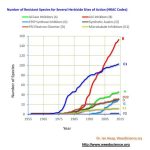
Mixtures or arrangements of herbicides with opposing modes of action are important especially to prevent or overcome resistance based on target site differences. The addition of CMPP or Galaxy to Ally will give improved control of many weeds as well as providing an alternative mode of action. Crop rotations may allow variance herbicides or farming methods to be recycled and may also deliver diverse inexpensive environments to variation the weed flora. The number of resistant species for herbicide sites of action is given in figure 1.
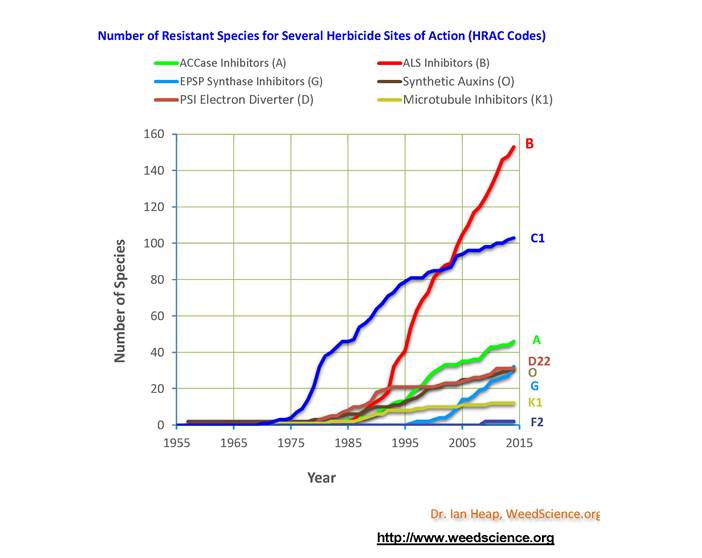
Fig. 1. The number of resistant species for several herbicide sites of action
Future lines of work
Due to weeds losses in quality and yield occur in wheat. Producers can gadget weed controlling systems that include cultural, chemical and preventive control methods to minimalize these injuries. Herbicide treatments are accessible to regulate weeds in wheat at evenhanded expenses. Producers should read and monitor guidelines on the herbicide tag to safeguard the effective and safe use of herbicides. In spring the best time to apply pre-emergence herbicides is about 10-14 days prior to the expected germination period.
The International Survey of Herbicide-Resistant Weeds, on the Weed Science website is an excellent mean of global evidence and appreciated reserve that optimistically will be preserved. The inadequate number of different weed species where resistance has previously established was measured in relative to their inhabitant’s ecology and reaction to diverse herbicides.
To reduce the use of herbicide some suggestions are given below:
- Use precision cultivators and turning hoe as conceivable
- Use herbicides only when soil and weather conditions are suitable for operative weed control.
- Weed PREVENTION! strategy
- Usage of band treatments over the cultivation and row in between rows
- Selective flaming or steam treatment may be appropriate in some situations (more research needed)
- Practice herbicides only that time when weeds are present in liable stage.
- Appropriately sustain application equipment and correctly standardize
- Wipe-on technology usage in those fields where weeds growing above the crop
- Exploit competition from valuable plants
- Usage of cover crops will also decrease winter annual weeds.
Choosing the correct variety for a definite paddock can provide considerable improvements in yield. Growers and advisors should check performance under weed pressure (if a standout variety in NVT results is found) to make sure it is suitable for the growing conditions. Competitive varieties are an integral part of integrated weed management systems and should be considered when planning for weed control. By increasing seeding rates we can improves yield by out competing with weeds and reduce the amount of weeds that set seed. These recommendations are not ancillary for pesticide labels. The tag delivers complete information data on protection and correct use of the herbicide. Read the whole tag formerly smearing any pesticide.
Acknowledgement
The authors are highly thankful to PMAS ARID Agriculture, University Rawalpindi, Pakistan, for supporting in the accomplishment of this study without any inconvenience and the co-authors which were always there to help in any means.
Conflict of Interest
The authors confirm that this article content has no conflict of interest.
References
Abbas, G., Ali. M., Abbas. A., Aslam. Z., Akram. M., 2009. Impact of Different Herbicides on Broadleaf Weeds and Yield of Wheat. Pak. Jou. of Weed Sc. Res., 15: 1-10.
Albrecht, H., Mattheis. A., 1998. The effects of organic and integrated farmin gonrare arable weed sonthe for schungsver bund Agrar-okosysteme Munchen (FAM) research station in southern Bavaria. Biol. Cons., 86: 347–356.
Andreasen. C., Stryhn. H., 2008. Increasing weed flora in Danish arable fields and its importance for biodiversity. Weed Res., 48: 1–9.
Anonymous., 2014. Pakistan Economic survey 2014-15. Ministry of finance, government of Pakistan. 22p. (Assessed at http://www.finance.gov.pk/survey_1213.html on 25).
Anwar, F., Bhanger I.M., Kazi. G.T., 2003. Relationships of rancimat and AOM values at
Balancing People, Planet, Profit: 14th Australian Weeds Conference Proceedings, Sindel, B.M. and S.B. Johnson (Eds.). Weed Society of New South Wales, Australia, pp: 558-561.
Boutin, C., Strandberg. B., Carpenter. D., Mathiassen. K.S., Thomas. J.P., 2014. Herbicide impact on non-target plant reproduction: What are the toxicological and ecological implications? Environ. Pollu., 185: 295-306.
Boutin. C., 2013. Herbicides: non-target species effect In: Jorgensen, S.E. (Ed.), Encyclopedia of environmental Management, volII. Taylor and Francis, New York., pp: 1406–1417.
Carpio, C., Sydorovych. O., Marra. M., 2007. Relative importance of environmental attributes using logistic regression. Southern agricultural economics association annual meeting, February 4-7, 2007, mobile, Alabama 34846.
Crone, E.E., Marler. M., Pearson. E.D., 2009. No-target effects of broad leaf herbicide on a native perennial for b: a demographic frame work for assessing and minimizing impacts. J. Appl. Ecol. 46,673–682.
Fried. G., Petit. S., Dessaint. F., Reboud. X., 2009. Arable weed decline in Northern France: crop edges as refugia for weed conservation? Biol.Conserv., 142: 238-243.
Golan, E., Kuchler. F., Mitchell. L., 2000. Economics of Food Labeling. Agricultural Economics Report No 793. Economic Research Service, USDA.
Guttieri, M.J., Jeffrey. C., Brien. O., Souza. K.S., 2001. Relative Sensitivity of Spring Wheat Grain Yield and Quality Parameters to Moisture Deficit. Crop Sci., 41: 327-335. http://dx.doi.org/10.2135/cropsci 2001. 412327 x.
Heap. I., 2007. The International Survey of Herbicide Resistant Weeds. http://www.weedscie nce.com
Holm, G., Plucknett. D., Pancho.J., Herberger. J., 1977. The World’s worst weeds: Distribution and biology.
Hurst, L.D., 1994. Cytoplasmic Genetics under Inbreeding and Outbreeding. Proceedings: Bio Sci., 258: 287-298.
Hussain, F., Murad. A., Durrani. J.M., 2004. Weed communities in the wheat fields of Mastuj, District Chitral, Pakistan. Pak. J. Weed Sci. Res., 10: 101-108.
Hussain, S.S., Khatoon. S., Mahmood. R., 2000. Report on Alien Invasive Species of Pakistan. Collaborative Study of IUCN Pakistan, CABI Rawalpindi and Botany department, Karachi University, Karachi.
Jalis, A., Muhammad. K., 1980. Post-emergence trial on Wheat. Annual abridge research report (1979-1980), Plant physiology section, Ayub agricultural research institute, Faisalabad.
Khalil, M.F., Hassan. G., Ahmad. G., Shah. H.N., 2008. Individual and combined effect of different herbicides on weed control in wheat. Pak. J. Weed Sci. Res., 14: 131-139.
Khan, 1., Hassan. G., Marwat. B.K., 2002. Efficacy of different herbicides for controlling weeds in wheat crop-II. Weed dynamics and herbicides. Pak. J. Weed Sci. Res., 8: 41-47.
Khan, I., Muhammad, Z., Hassan. G., Marwat, K.B., 2001. Efficacy of different herbicides for controlling weeds in wheat crop-1.response of agronomic and morphological traits in variety Gaznavi-98. Scientif. Khyb., 14: 51- 57.
Marwat, K.B., Saeed. M., Hussain. Z., Gul. B., 2005. Chemical weed management in wheat in rainfed areas-I. Pak. J. Weed Sci. Res. 11: 31-36.
Noorka, I.R and Shahid. A.S., 2013. Use of Conservation Tillage System in Semiarid Region to Ensure Wheat Food Security in Pakistan. Development in Soil Salinity.
Noorka, I.R., Batool. A.,, AlSultan. S., Tabasum. S., Ali. A., 2013. Water stress tolerance, its relationship to assimilate partitioning and potence ratio in spring wheat. Amer. Jour. of Plant Sci., 4: 231-237.
Qureshi, M.A., Jarwar. S.A., Tunio. D.S., Majeedano, I.H., 2002 Efficacy of various weed management practices in wheat. Pak. J. Weed Sci. Res., 8: 63-69.
Reeves, T., 2006. Design research from a technology perspective. In J. V. D. Akker, K. Gravemeijer, S. McKenney & N. Nieveen (Eds.), Educational design research (pp: 52–66). New York: Routledge.
Romero, A., Chamorro. L., Sans. X.F., 2008. Weed diversity in crop edges and inner fields of organic and conventional dryland winter cereal crops in NE Spain. Agri. Ecosyst. Envi., 124: 97–104.
Singh, S.P., Pandey. P., Kumar. M., Singh. S., Pandey. S.N., Srivastva. D., 2013. Growth and biochemical responses of Wheat (Triticum aestivum L.) to different Herbicides. Afri. Jour. of Agri. Res., 8: 1265- 1269.
Storkey, J., Meyer. S., Still. S.K., Leuschner. C., 2012. The impact of agriculture in tensification and land-use change on the European arable flora. varying temperatures for several oils and fats. J. Am. Oil Chem. Soc., 80: 151-155.
Sutcliffe, O.L., NKay. O.Q., 2000. Changes in the arable flora of central southern England since 1960s. Biol. Conserv., 93: 1–8.
Sydorovych, O., Marra. M., 2007. A Genetically engineered crop’s impact on pesticide use: A revealed-preference index approach. Jour. of Agri. and Res. Eco: 32: 476-491.
Sydorovych, O., Marra. M., 2008. Valuing the changes in herbicide risks resulting from adoption of roundup ready Soybeans by U.S. farmers: A revealed-preference approach. Jour. of Agri. and Appli. Econ. 40: 777-787.
Tatarkova, V., Hiller. E., Vaculı. M., 2013. Impact of wheat straw biochar addition to soil on the sorption, leaching, dissipation of the herbicide (4-chloro-2-methylphenoxy) acetic acid and the growth of sunflower (Helianthus annuus L). Ecotoxic. and Envir. Safety., 92: 215–221.
Türe, C., öcük. B.H., 2008. Investigation of threaten edarable weeds and their conservation status in Turkey. Weed Res., 48: 289–296.
Zimdahl, R., 1999. Fundamentals of Weed Science. Academic Press, San Diego, USA.