Yield Performance and Factor Analysis for Superior Cultivars Identification in Wheat (Triticum aestivum L.)
Department of Genetics, Hazara University, Mansehra, 21300-Pakistan.
*Corresponding author:
Muhammad Kamran;Email:
kamigenet@gmail.comReceived: 09.Nov.2015, Accepted: 13.Feb.2016
Views 3735
Abstract
The purpose of our study was to differentiate the varieties of wheat depending on their morphological traits relating to yield and to estimate those factors which are responsible for the highest yield plant -1. The 26 different types of local wheat varieties were grown in the field conditions of Hazara University Mansehra, seeded in a Randomized Complete Block Design (RCBD) with 3 replications. Some of the Morphological traits were significant namely, spike length, flag leaf area, awn length, grains per spike, spikelets per spike, number of tillers, peduncle length, grains weight, and grain yield but others were non-significant such as, leaf angel, days to headings, days to maturity, plant height and harvest index. Kaghan-93 (7.77g plant-1) was seen to be the highest production of yield and was observed best within 26 varieties. Factors examination exposed 5 essential factors that estimated 73.24% of the total differences, depending on principal component processes. One of these was awn length that seems to be 18.83% in the direction of the yield. While the second and third component were (16.38%) and (14.53%) for yield component and plant architecture respectively. The fourth factor was the growth factor which was estimated upto 12.86% and maturity parameters was 10.26%. Depending on these factors selection will be conducive to use highest yield genotypes and are suggested for further crop renovation programs.
Keywords
Wheat, morphological traits, varieties, harvest, parameters.
Citation
Kamran, M., Inamullah, Iqbal, M.S., 2016. Yield Performance and Factor Analysis for Superior Cultivars Identification in Wheat (Triticum aestivum L.). PSM Biol. Res., 01(1): 11-15.
Introduction
One the world’s biggest wheat producing country is Pakistan with almost 23.42 million tons with its sophisticated region of 9.062 million hectare, while the production of grain obtained is 2585 kg/hectare (Anonymous, 2009). The increasing population day by day is one of the biggest factors to divert our attention towards the maximum yield of crops on sustainable foundations (Inamullah et al., 2006). Agricultural characteristics are generally perceptible involving the grain production and responsible for the factors including either directly or indirectly (Khan and Dar, 2009; Ali et al., 2009). It is clearly implicit that grain yield in wheat included a variety of components and the factors such as cultivar appropriateness, husbandry and ecological circumstances affect these components. Thus, the aims of the propagation programs are to get the maximum production of grains (Inamullah et al., 2006).
The Assortment method of yield and its component’s relationship is difficult to understand, which can be easily understood by using different types of mathematical analysis (Guertin and Bailey, 1982). By using the multivariate technique it is reported that factor analysis is responsible for involvement of variables in fraction and giving additional information as compared to simple correlation matrix (Biabani and Pakniyat, 2008). Moreover, different types of variables are minimized to hidden factors by factor analysis and provide further knowledge and instructions (Azizi et al., 2001). The present study was planned to differentiate the varieties of wheat depending on their morphological traits relating to yield and to estimate factors responsible for the highest yield plant -1.
Materials and Methods
The current study was conducted in investigational grassland of Department of Genetics, HUM (Pakistan) in 2010-2011 (the Rabi season). 26 different types of samples were grown-up in a RCBD with 3 types of study area. In investigational field each row having the distance of 30 cm between them was indicated as an experimental unit. 5 randomly special plants (not taking into account borders) were collected from all rows at the suitable development of plant, for diverse morphological characteristics. Number of tillers on each plant, days to 50% headings, flag leaf area, plant tallness, leaf position, peduncle, spike and awn length, spikelets per spike, days to maturity, number of grains per spike, harvest index, yield per plant and 1000 grains weight were the morphological characteristics. Data were calculated by LSD and ANOVA for demonstrating the results of significance and difference within traits which is being studied by utilizing statistical software namely ‘MSTATC’ while ‘SPSS’ (ver.16) was applied for factors analysis to demonstrate the results about contributory components.
Results and Discussion
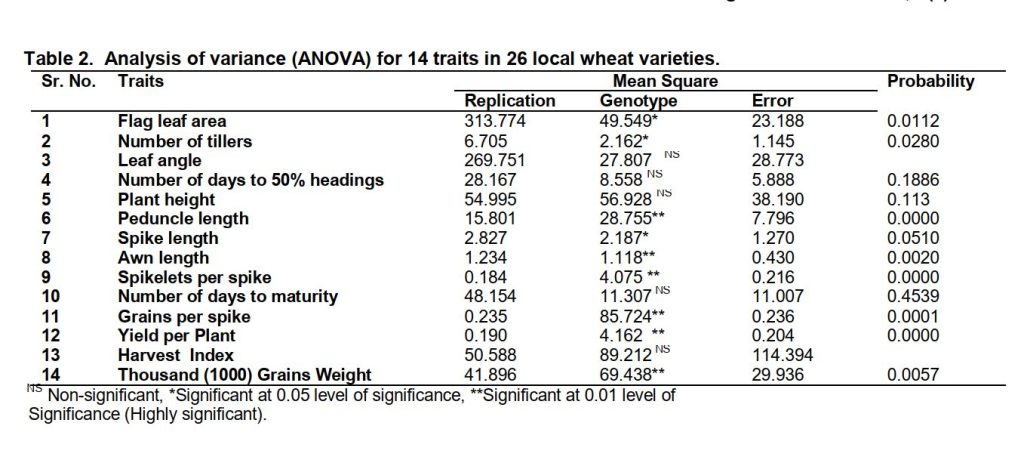
Genetic distinction was overdone by least significant differences within of 26 different types of local wheat samples as presented in Table 1. By applying ANOVA it was found that the traits were significant except for some factors such as, days to headings, leaf angle, plant tallness, harvest index and days to maturity. A trait that was noted to be non-significant should be abused further to get significant results. The seasonal circumstances such as rainwater, temperature variations, wetness contents accessibility, and suitable time of sowing should be in deliberation to achieve maximum productivity of traits that are important (Iqbal et al., 2010).
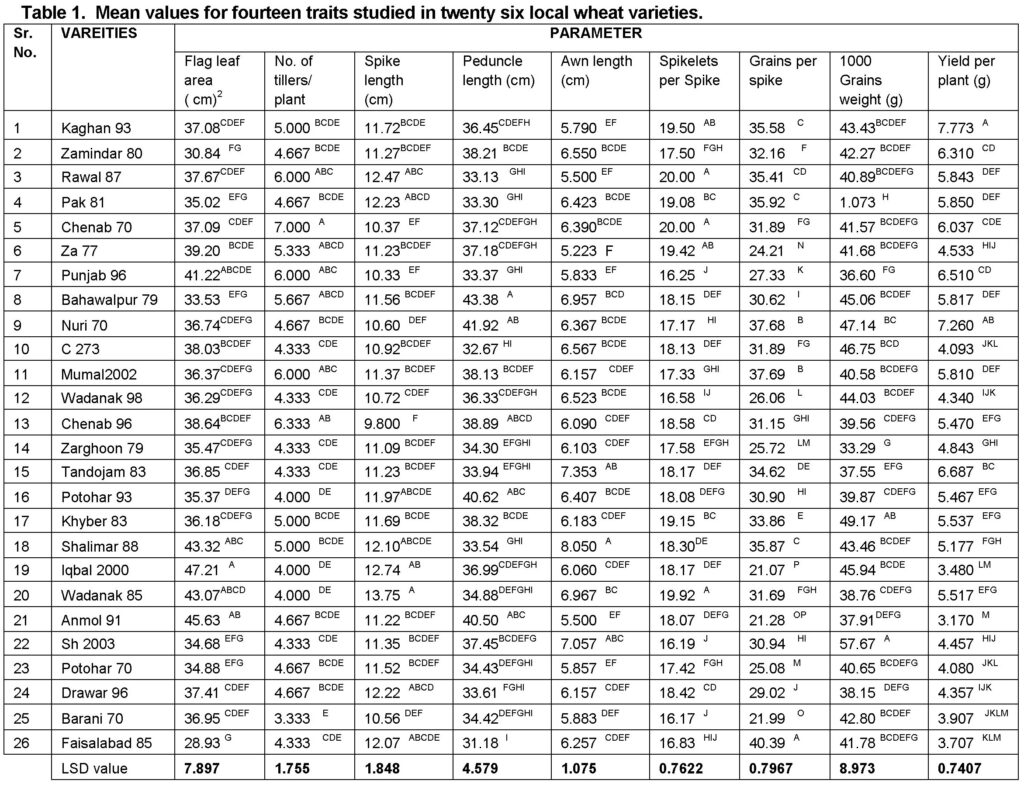
The significant value for the biggest flag leaf area was illustrated in table 2 (Iqbal-2000) while Chenab-70 seemed to be the highest number of tillers. Wadanak-85 was noted having highest spike length while in Bahawalpur-96 highest peduncle length was noted. In Shalimar-88 longest awn length was recorded and elevated number of spikelets on each spike were recorded in ZA-77 and Chenab 70, respectively, While highest grains per spike was noted in Faisalabad-85, highest 1000 grain weight was seen in SH-2003 and maximum yield per plant in Kaghan-93. In Chenab-70 (7.00) the maximum number of tillers was obtained and these conclusions are sustained by the results of Kahrizi et al., (2010). The findings about the grains quantity on each spike were greatest in Faisalabad-85 (40.39g) which are in accordance to Hussain et al. (1997). Furthermore, Jabbar et al. (1999) illustrated that grain number is varying within the range 40-59 grains per spike among different genotypes of wheat. 1000 grain weights seemed to be considerable in the SH-2003 (57.67g), which is in agreement with the conclusion of previous researchers (Afzal and Nazir, 1986; Sharar et al.,1989). There is maximum plant height of 70-100 cm, reported by Fischer and Quail (1990) and Richards (1992) which is in agreement with our results. These best quality varieties are important and could be utilized for broad choice of hybridization and breeding programs.
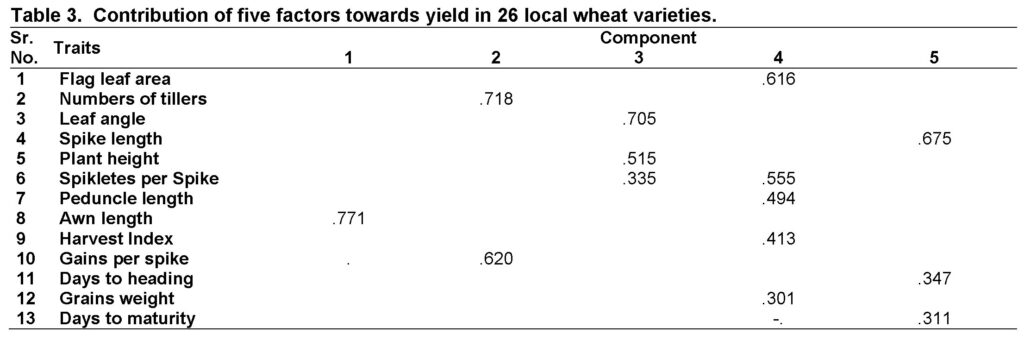
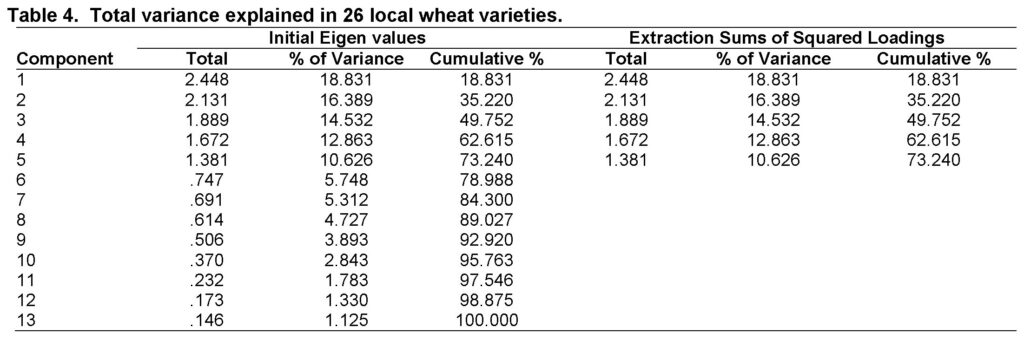
To conclude the traits relationship and to discover the traits that are hidden, factor analysis was implemented (Table 3). As factor analysis can be integral of stage regression analysis and path coefficient analysis citing supplementary information (Azizi et al., 2001). Each factor is influenced by some traits which is resultant of characteristics (Mansouri et al., 2004). 5 factors represents 73.24% of total deviations was calculated by factor examination (Table 3). The first one indicated 18.83% of production of grains and awn length (Table 4). These findings are in agreement with Vahid et al., 2011. The contribution of number of tillers and grains per spike indicated that the second one was 16.38% of yield component. Some factors (the length of spike, peduncle and fertile tiller) are called plant growth factor (Vahid et al 2010). Third factor was 14.53% of variation (plant height, leaf angle and spikelets per spike) which was recognized as plant structural design. The fourth factor in which included the flag leaf region, spikelets on each spike, peduncle extent, harvest index and grains weight and called as growth factor (12.86% to yield). The fifth factor (Spike length, days to development and days to 50% headings) was maturity parameters with 10.62% involvement in the direction of yield.
Conclusion and Suggestions
The current study suggested that the best genotype according to the highest yield is Kaghan-93 especially in Hazara region circumstances. In propagation potential, selection of such genotypes ought to be prepared depending on several factors namely, awn length, number of tillers, plant height and production of grain yield to fulfill the highest production of grain needs in the kingdom.
Acknowledgement
The authors are highly thankful to their dearest supervisors Dr. Inamullah and Dr. Sajjad Iqbal for technical support during this research work.
Conflict of Interest
The authors confirm that this article content has no conflict of interest.
References
Afzal, M., Nazir, M.S., 1986. Response of two semi dwarf wheat varieties to sowing dates. J. Agric. Res., 24: 110-14.
Ali, M. A., Anwer, J., Hussain, M., Sabir, W., Khan, M.A., Zulkiffar, Abdullah, 2009. Assessment of yield criteria in bread wheat through correlation and path analysis. J. Anim. Plant Sci., 19(4): 185-188.
Anonymous, 2009. Economic Survey, Economic Affairs Division, Govt. Pakistan., Islamabad.
Anonymous. 2011. International Grains Council. GMR No. 412 30 June 2011.
Ashfaq, M., Khan, A.S., Ali, Z., 2003. Association of morphological traits with grain yield in wheat (Triticum aestivum L.). Int. J. Agric. Biol., 5: 262-264.
Azizi, F., Rezaie, A.M., Mir, A.M., Meibodi, M., 2001. Evaluation genetic and phenotypic variation and factor analysis on morphological traits in bean genotypes. J. Sci. Technol. Agric. Nat. Resour., 5: 127-140.
Biabani, A.R., Pakniyat, H., 2008. Evaluation of seed yield related characters in sesame (Sesamum indicum L.). Pakistan J Biol Sci., 11: 1157-1160.
Fischer, R.A., Quail, K.J., 1990. The effect of major dwarfing genes on yield potential in spring wheat. Euphytica, 46: 51-56.
Guertin, W.H., Bailey, J.P., 1982. Introduction to modern factor analysis. Edvards Brothers Inc., Mishigan. 405p.
Hussain, A., Maqsood, M., Ahmad, A., Wajid, A., Ahmad, Z., 1997. Effect of irrigation during various development stages on components of yield and harvest index of different wheat cultivars. Pakistan J. Agric. Sci., 34: 104-107.
Inamullah, Ahmad, H., Muhammad, F., Din, S., Hussain, G., Gul, R., 2006. Diallel analysis of the inheritance pattern of agronomic traits of bread wheat. Pak. J. Bot., 38(4): 1169-1175.
Inamullah, Ahmad, H., Muhammad, F., Din, S., Hussain, G., Gul, R., 2006. Evaluation of the heterotic and hetrobeltiotic potential of wheat genotypes for improved yield. Pak. J. Bot., 38(4): 1159-1167.
Jabbar, A., Saeed, M., Gaffar, A., 1999. Agrochemical weed management in wheat. Pakistan J. Agric. Sci., 36: 33-38.
Kahrizi, D., Cheghamirza, K., Kakeai, M., Mohammadi, R., Ebadi. A., 2010. Heritability and genetic gain of some morphophysiological variables of durum wheat (Triticum turgidum var. durum). Afr. J. Biotechnol., 9(30): 4687-4691.
Khan, M.H., Dar. A.N., 2009. Correlation and path coefficient analysis of some quantitative traits in wheat. Afr. Crop Sci. J., 18(1): 9-14.
Mansouri, S., Soltani najaf Abadi, M., 2004. Evaluation and systemic analysis of yield relationship between its components for breeding of sesame (Sesamum indicum L.). Seed and Plant J., 20: 167-149.
Ministry of Food Agriculture and Live Stock, Islamabad Pakistan. 2011.
Richard, R.A., 1992. The effect of dwarfing genes in spring wheat in dry environments. I. Agronomic characteristics. Aust. J. Agric. Res., 43(3): 517-527.
Sharar, M.S., Yaqub, M., Ayub, M.,1989. Growth and yield of five wheat genotypes as influenced by different irrigation frequencies. Pakistan Sci. Ind. Res. 2: 344-5.
Vahid, M., Shahreyari, R., Imani, A.A., khayanezad, M., 2011. Factor analysis of wheat quantitative traits on yield under terminal drought. American-Eurasian J. Agric. Environ. Sci., 10 (2): 157-159.