Isolation and Identification of Fungal Post-harvest Rot of Some Fruits in Yemen
*Corresponding author:
Amira Ali Mohammed Al-harethiEmail:
amira-ali1@hotmail.comReceived: 19.Jun.2016; Accepted: 20.Jul.2016
Views 3882
Abstract
The physiological studies on fruits rotting fungi in Yemen are scarce. This work was designed to study the biodiversity of fungal post-harvest decay of apple, orange, banana, mango and grape fruits sold in local markets in Sana’a city, Yemen. A total of 150 rotted fruits samples were collected from different local markets, small pieces of mouldy part were inoculated on prepared plates of Potato dextrose agar (PDA), after 7 days of incubation, pure isolated fungi were identified according to the recommended references. The most common spoilage fungi which isolated and identified was Penicillium expansum (apple), Colletotrichum musae (banana), Aspergillus terreus, (orange), Aspergillus niger (mango) and Penicillium glabrum (grape). Several fungal species (39) belonging to 16 fungal genera could be regarded as post-harvest decay of apple, orange, banana, mango and grape fruits in Sana’a market. Proper measures should be adopted to protect fruits from fungal decay.
Keywords
Post-harvest, Aspergillus, Penicillium, Colletotrichum, rot and spoilage.
Citation
Abdullah, Q., Mahmoud, A., Al-harethi, A., 2016. Isolation and Identification of Fungal Post-harvest Rot of Some Fruits in Yemen. PSM Microbiol., 01(1): 36-44.
Introduction
It has been recognized that fruits are commercially and nutritionally important food product. Fruits play an important role in human nutrition by contributing the necessary growth factors such as vitamins and essential minerals in human daily diet maintaining a good and normal health. Rot diseases caused by fungal pathogens provoke severe losses of agricultural and horticultural crops every year (Salman 2005; Parveen et al., 2016). Fruits have wide distribution in nature. The relatively short shelf-life period provoked by pathogens is one of the most important limiting factors that impact the economic value of fruits. Approximately 20-25% of the harvested fruits are deteriorated by pathogens during post-harvest handling even in advanced countries (Droby, 2006; Zhu, 2006).
The postharvest losses are often more harsh in developing countries due to lack ofstorage and transportation facilities. Fruit infections by fungi may appear during the growth period, harvesting, handling, transportation and post-harvest stockpile and marketing conditions, or after procuring by the consumer. Fruits incorporate high levels of nutrients element and sugars and their low pH values make them exceptionally desirable to fungal decay (Singh and Sharma, 2007). Fungi are considered as an essential post-harvest losses agent of different fruits, based on cultivar, season and production area amid other factors (Valiuskaite et al., 2006; Ewekeye et al., 2016).
Fungi are the most crucial and common pathogens and the mean cause of crop diseases. It Infect a wide range of fruits and vegetables during storage and transportation (Sommer, 1985).
Rotted fungi are ubiquitous biological agents that are able to infect fruits because of their ability to produce a wide range of hydrolytic enzymes. Mould growth depends on many factors such as pH, water activity (aw), temperature, atmosphere, time, etc (Magan, and Aldred, 2007).
As reported by Yemeni Ministry of Agriculture and Irrigation, (2011) the total cultivated area of fruits was reported to be 93,989 acre yielding 991,091 tons per year. This study was aimed in isolation and identification of the mycobiota associated with post-harvest decay of apples, oranges, bananas, mangoes and grapes from different localities in Sana’a markets. Yemen.
Materials and Methods
Collection of samples
One hundred and fifty samples of mouldy fruits including thirty samples of each of apples, banana, oranges, mangos and grapes were randomly collected from some markets in Sana’a city from December 2011 to august 2012. The weight of each sample was nearly 250 g. Samples were separately kept inside clean plastic bags, transferred to the laboratory and stored in a refrigerator until mycological analysis.
Isolation and identification of fungi
The direct plating technique described by Pitt and Hocking (1985) was employed. Four small pieces from the margin of lesion of each sample were directly inoculated on prepared plates of Potato dextrose agar which contain (g/L): peeled potato100.0g, glucose 20.0g, agar 15.0g, water 1000.0 ml. The medium was supplemented with chloramphenicol (250 mg per liter) as a bacteriostatic agent (Smith and Dawson, 1944). The plates were inoculated at 28 ± 1 oC for 5 to 7 days. Three replicates were prepared for each sample. The resulting fungi were isolated, purified and identified according to their macro and micro characteristics.
Identification of fungal genera and species
The pure isolated fungi were identified following the most documented keys in fungal identification (Raper and Fennell et al. 1965; Pitt 1979; 1985, Moubasher, 1993; Klich, 2002).
Statistical analysis
Data obtained was analyzed statistically using SPSS (Version 16).
Results
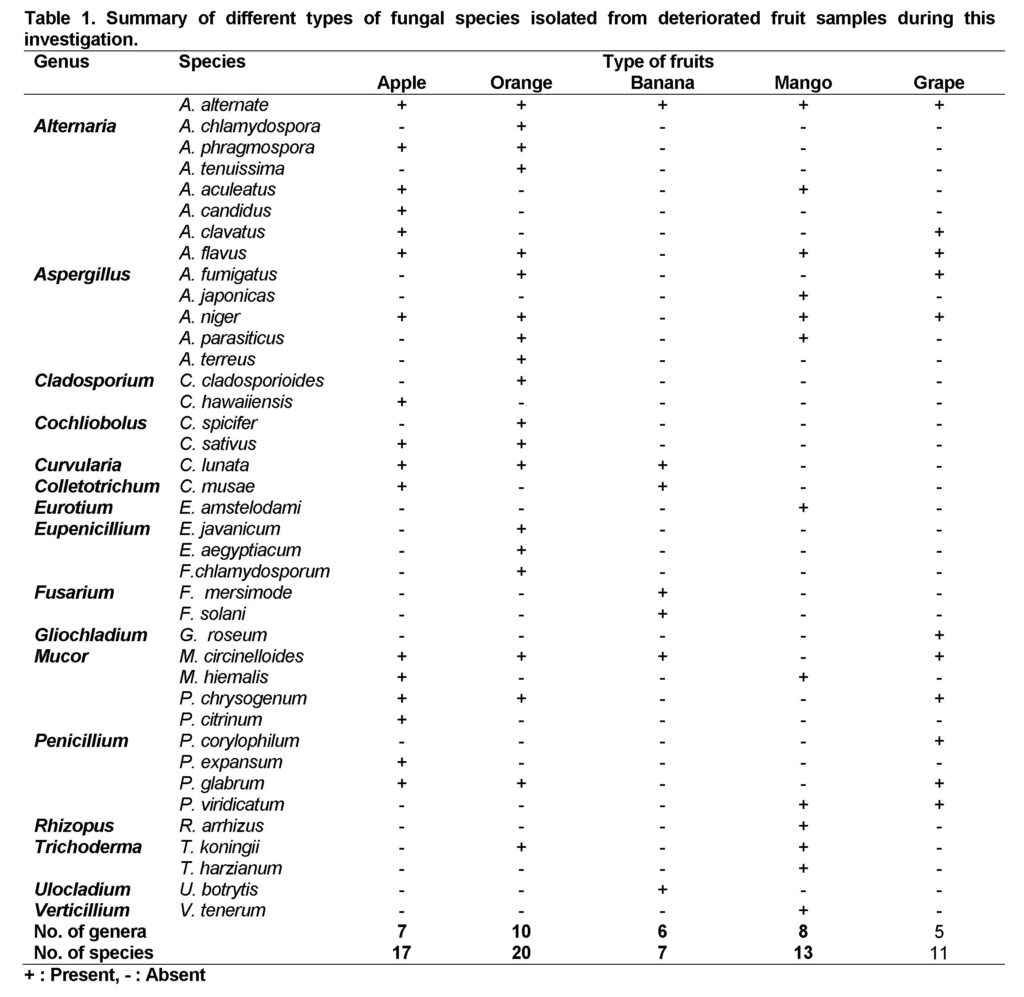
The biodiversity of fungal species listed in table (1) could be regarded as common post-harvest decay agents of various studied fruits. Through this investigation at 28oC thirty nine fungal species attributed to sixteen genera were isolated. Thirty-nine species belonging to 16 fungal genera were isolated from 150 samples of mouldy fruits collected from different localities in Sana’a markets. Alternaria, Aspergillus and Penicillium were the most common genera that colonized apple, orange, banana, mango and grape fruits with different incidences (Figure 1). In which Aspergillus were represented by(9 species), Penicillium (6 species) and Alternaria (4 species) contributed the broadest spectra fugal species.
Aspergillus species were classified according to Raper and Fennell. (1965) to the following species: A. aculeatus, A. candidus, A. clavatus, A. flavus, A. fumigatus, A. japonicus, A. niger, A. parasiticus and A. terreus.
Penicillium species were classified according to Raper and Thom (1949) to the following species: P. chrysogenum, P. citrinum, P. corylophilum, P. expansum, P. glabrum and P. viridicatum.
Alternaria contained 4 species namely A. alternata, A. chlamydospora, A. phragmospora and A. tenuissima. Cochliobolus and Fusarium were represented by 3 species for each namely C. hawaiiensis, C. sativus, C. spicifer, F. chlamydosporum, F. mersimode and F. solani.
Eupenicillium, Mucor and Trichoderma were represented by 2 species for each; E. aegyptiacum, E. javanicum, M. circinelloides, M. hiemalis, T. harzianum and T. koningii.
The remaining genera Cladosporium, Colletotrichum, Curvularia, Eurotium, Gliochladium, Rhizopus, Ulocladium and Verticillium were represented by one species only namely C. cladosporioides, C. musae, C. lunata, E. amstelodami, G. roseum, R. arrhizus, U. botrytis and V. tenerum.
It is worth to mention that C. musae, G. roseum and E. javanicum are new record to the microbial laboratory, biology department, faculty of science, Sana’a University.
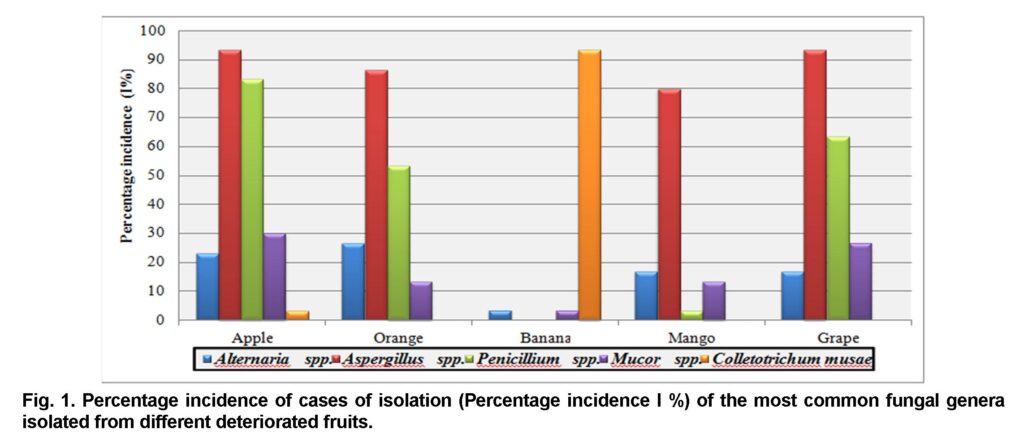
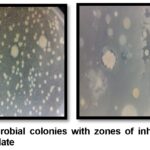
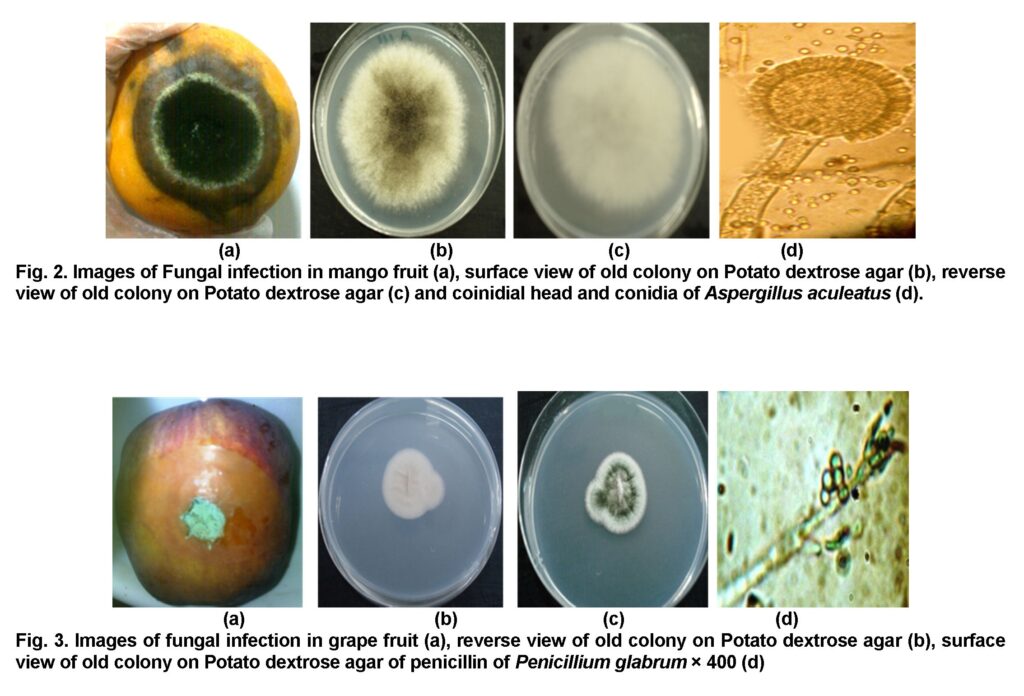
Aspergillus was by far the most common genus affecting the different kinds of fruits. It appeared on 93.3 % of each of apple and grape fruits. 86.6% of orange fruits and 80.0 % of mango fruits.A. flavus and A. niger were the dominant species on the tested fruits. The highest incidence of A. niger was observed on orange fruits followed by grape fruits (60.0% and 56.6%, respectively). Whereas A. flavus was found to be common on apple fruits followed by grape fruits (60.0% and 30.0%, respectively). Figure (2) show the macro and microscopic characters of A. aculeatus.
Penicillium was the second most common genus especially on apple (83.3%) followed by grape (63.3%) and orange (53.3%), P. chrysogenum and P. glabrum appeared with variable incidences on most kinds of tested fruits. Other species showed higher affinity towards certain fruits such as P. expansum on apple fruits. Figure (3) show the macro and microscopic characters of P. glabrum.
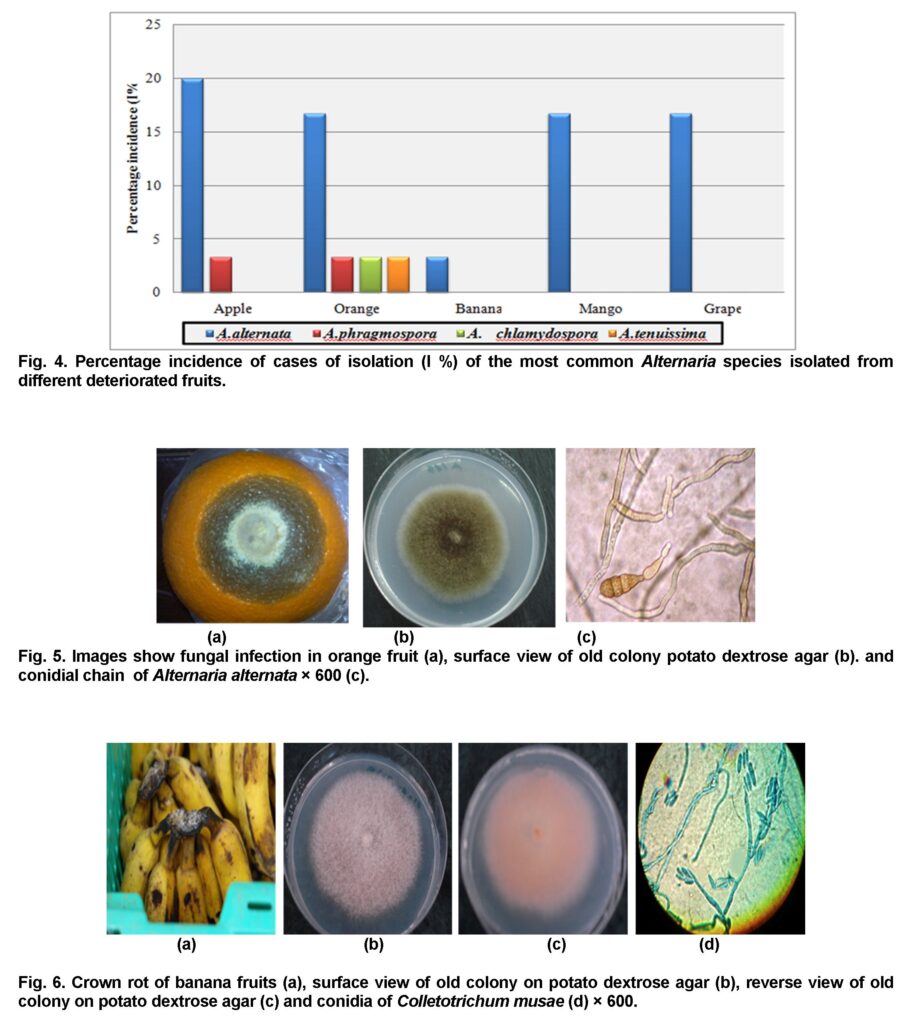
Figure (4) showed that Alternaria (represented by A. alternata, A. chlamydospora, A. phragmospora and A. tenuissima) ranked third in abundance on decayed fruits. It was more common on orange (26.7%) followed by apple (23.3 %) and finally on mango and grape (16.6 % for both). A. alternata was occurred more frequently than other species. Figure (5) showed the macro and microscopic characters of A. alternate. During this study, Colletotrichum musae* proved to be the main causative agent of banana rot where it was found on 93.3% of its tested samples. Figure (6) show the macro and microscopic characters of C. musae.
Discussion
This investigation embraces an extensive survey of the mycobiota associated with post-harvest rot of fruits in 150 samples collected from different localities in Sana’a markets. The tested samples comprised apple, banana, orange, mango and grape fruits (30 samples for each).
In this respect, Akinmusire (2011) and Chukwuka et al. (2010) mentioned that fruits can affected by a wide range of microorganisms such as fungi which have a serious threat to production of fruits. Spoilage attributes to any change in the condition of food making it less palatable, or even toxic; these alterations may be accompanied by changes in taste, smell, appearance.
During the first part of this investigation, it was possible to isolate 39 species belonging to 16 fungal genera from the 150 samples of the mouldy fruits. The broadest spectrum of fungal species was recovered from orange fruits (20 species).
The findings of this study showed that, Aspergillus was the genus most frequently isolated from the different kinds of mouldy fruits being recovered from 0 % to 93.3% of samples with the highest incidence observed on apple and grape and the comparatively no incidence from banana. On orange and mango fruits Aspergillus was recovered in 86.7% and 80% of the samples. Among the 9 species of Aspergillus, A. niger and A. flavus were the most common species. They were respectively recovered from 20% – 60% and 13.3% – 60.0% of the different mouldy fruits sample.In India, the isolation of these pathogens confirmed by Fatima et al. (2012) who found that the long time that taken in transportation of fruits through country as well as increasing in humidity, favors the development of Aspergillus rot of fruits. Al-Hindi et al. (2011) reported that Aspergillus spp. were found to be the most spoilage fungi among all examined spoilage fruits. And he found that A. niger was a commonly fungus on grapes (Chulze, 2006), apples (Oelofse, 2006) and orange (Gadgile and Chavan, 2010).
In Ibadan, Oyo State, South Western Nigeria, Baiyewu et al. (2007), Bali et al. (2008) and Chukwuka et al. (2010) found that A. niger and A flavus were the main responsible for deterioration of orange fruits in major markets. These two species were previously recorded as causative agents of citrus fruits decay during storage in the same country (Fawole and Odunfa, 1992). In addition, in Greece, Egypt and Morocco Paola et al. (2008) found that Aspergillus rot of grape that caused by A. niger and A. flavus usually severe in the warmer grape-producing areas.
The most common fungal species isolated from infected mangoes in Saudi Arabia were identified as A. niger and Alternaria sp. (Al-Hindi et al.., 2011). However, Fatima et al. (2012) found that the main fungi that responsible for post-harvest deterioration of fresh fruits in Pakistan were identified as A. flavus, A. niger. In other studies, A. niger and A. flavus were the responsible for decay of mango fruits in post-harvest phase (Prusky and Yakaby, 2003;Diedhiou, et al., 2007 and Muhammad et al., 2011).
Penicillium was the second most frequent genus on the tested fruit samples. It showed its highest incidence on apple fruits, followed by grape and orange fruits. Penicillium was rare on mango fruits, while there was no occurrence of Penicillium on banana fruits examined during this study. The genus was represented by 6 species of which, P. chrysogenum was the most common especially on orange, apple and grape fruits. P. glabrum was fairly common on grape, apple and orange fruits. P. expansum and P. citrinum were appeared only on apple fruits and was missed on other kinds of tested fruits.
In agreement with our results, Snowdon (1990) and Benkhemmar et al. (1993) found that Penicillium spp. such as P. chrysogenum, P. citrinum, P. glabrum and P. viridicatum are common pathogens of stored grapes. In a previous study, Narayanasamy (2006) reported that Penicillium appeared to be the most fungal genus infected fruit crops such as apple, citrus; grapes, pear, and strawberry. In addition, Barkai-Golan. (2001) and Paola et al. (2008) reported that many Penicillium species were the causative agent of post-harvest diseases in which they infect a wide range of crop.
On other hand P. expansum, was the main causes of blue mould rot of apples, pears and other fresh fruits, it is an example of the destructive post-harvest pathogens that cause a large part of the economic losses during post-harvest phase. Dov Prusky et al. (2010) found that P. expansum responsible for rotting apple fruits, in which it lead pH to decreases from 3.95 to 4.31 in the healthy mesocarp to values ranging from 3.64 to 3.88 in the rotting tissue.
Our data showed that Alternaria could be regarded as the third most frequent genus on the tested fruits. It occurred with different incidences in all kinds of fruits. Among 4 species of Alternaria, A. alternata was the commonest. These results conform with findings of Barry et al. (2003) who showed that from 218 fungal isolates isolated from lesions on different fruits, A. alternata resembled 96% of fungi responsible for Alternaria rot. In addition, A. alternata appeared to be the most common decay organism of post-harvest apple, where this species represented 81.9% 0f 110 strains of Alternaria isolated from decayed apples (Vinas et al., 1992).
In similar studies, Mansour et al. (2006), Haggag et al. (2009) and Muhammad et al. (2011) found that Alternaria black spot (A. alternata) had become the most important disease of fresh and stored fruits. Peever et al. (2005) stated that post-harvest black rot of fruit occurred mainly in citrus fruits and caused by different species of A. alternata.
The two species of Mucor identified during this investigation, were M. circinelloides and M. hiemalis. They occurred in low or rare incidence on the different kinds of fruits. In this respect, M. hiemalis in addition to M. mucedo and M. piriformis were found to cause decay of numerous fruits and vegetables including apples, guava, pears, peaches, strawberries and sweet potatoes (Moline, 1984). Different Mucor species were previously recorded to cause decay of different fresh fruits (El-Tahtawi, 2005).
During this study, Colletotrichum musae proved to be the main causative agent of banana rot. Scot. (2001) found that the two primary post-harvest rots of banana fruits in Hawai’i were crown rot and anthracnose caused by the fungus C. musae.Raut and Ranade (2004) and Ranasinghe et al. (2005) reported that, banana suffer from serious post-harvest losses caused by fungal infections, especially C. musae. Sulali et al. (2004) mentioned that from nine localities in Sri Lanka the fungal pathogen isolated from the anthracnose lesions of banana was identified as C. musae. In Taiwan, Chuang and Yang (1993) reported that banana anthracnose induced by C. musae was an important post-harvest disease and caused serious loss during transport. Similar findings were also reported in Sri Lanka. Fungal species belonging to Cladosporium, Eupenicillium, Eurotium, Gliochladium, Fusarium, Rhizopus, Trichoderma, Ulocladium andVerticillium were generally rare on the different kinds of the tested fruits.
Conclusion
Post-harvest pathology, earlier termed “market pathology”, refers to the science of, and practices for, the protection of harvested produce during harvesting, packing, transportion, processing, storage, and distribution. Several fungal species (39) belonging to 16 fungal genera could be regarded as most common causes of post-harvest deterioration of apple, orange, banana, mango and grape fruits in Sana’a market. Common species were Aspergillus niger, A. flavus, Alternaria alternata, Mucor circinelloides, Penicillium chrysogenum, P. expansum (on apple), Colletotrichum musae (on banana).
Recommendations
Considering the fact that the isolated fungi found on a group of fruits under- study, possess the ability to produce enzymes that could change the nutritious value of these fruits, leading to economical loss. Furthermore, these fungi can also produce several toxins within the examined fruits, resembling a public health hazard. This issue is of importance as the targeted fruits are priceless and mostly consumed by poor people (economically low-class people). For that we recommended the following:
- Fruits sales in markets should be under a clean-safe environment that would be unfavorable environment for the growth of such fungi.
- The concerning bodies should hold their responsibilities in following-up fruit-sales markets to ensure high-quality and toxic-free fruits.
- Proceeding further studies in this field, as this issue related to consumers health.
Acknowledgement
The authors would like to thank Sana’a University for Science for supporting this work.
Conflict of Interest
The authors declare that this article content has no conflict of interest.
References
Al-Hindi, R.R., Al-Najada, A.R., Mohamed, S.A., 2011. Isolation and identification of some fruit spoilage fungi: Screening of plant cell wall degrading enzymes. Afr. J. of Microbiol. Res., 5(4): 443-448.
Akinmusire, O.O., 2011. Fungal Species Associated with the Spoilage of Some Edible Fruits in Maiduguri Northern Eastern Nigeria. Advances in Environmental Biology, 2011; 5(1): 157-161.
Baiyewu, R.A., Amusa, N.A., Ayoola, O.A., Babalola O.O., 2007. Survey of the post-harvest diseases and aflatoxin contamination of marketed Pawpaw fruit (Carica papaya L) in South Western Nigeria. Afr. J. Agric. Res., 2(4): 178-181.
Bali, R.V., Bindu, M.G., Chenga, R.V., Reddy, K., 2008. Post-harvest fungal spoilage in sweet orange (Citrus sinensis) and acid lime (Citrus aurentifolia Swingla) at different stages of marketing. Agric. Sci. Digest., 28:265-267.
Barkai-Golan, R., 2001. Post-harvest diseases of fruits and vegetables, Development and Control. Amsterdam: Elsevier.
Barry, P., Mike, M., Patricia, F., 2003. Characterization of Alternaria isolates associated with Alternaria rot of citrus. Citrus Research Report, the University of Arizona College of Agric. and Life Sci., index at http://cals.arizona.edu/pubs/crops/az1331.
Benkhemmar, O., Lahlou, H., Dupont, J., 1993. Identification of different species of Penicillium causing deterioration of the Moroccan table grapes during storage. Mycopath., 124: 27–30.
Chuang, T.Y., Yang, H.R., 1993. Control of banana anthracnose . Biologica; Plant Pathol. Bulletine, 2:71-77.
Chukwuka, K.S., Okonko, I.O., Adekunle, A.A., 2010. Microbial ecology of organisms causing pawpaw (Carica Papaya L.) Fruit decay in Oyo State, Nigeria. American-Eurasian J. Toxicol. Sci., 2 (1): 43-50.
Chulze, S.N., Magnoli, C.E., Dalcero, A.M., 2006. Occurrence of ochratoxin A in wine and ochratoxigenic mycoflora in grapes and dried vine fruits in South America. Intl. J. Food Microbiol., 111:5-9.
Diedhiou, N.P., Mbaye, A., Samb, P.I., 2007. Alteration of post-harvest diseases of mango Mangifera indica through production practices and climatic factor. Afr. J. Biotech., 6 (9): 1087-1094.
Dov Prusky, N.A., Itay, M., Shiri, B., Maayan, D., Droby S., 2010. Improving quality and safety of fresh fruits and vegetables after harvest by the use of biocontrol agents and natural materials. Acta Horticulture, 709: 45–51.
Droby. S., 2006. Improving quality and safety of fresh fruits and vegetables after harvest by the use of biocontrol agents and natural materials. Acta Horticul., 709: 45–51.
El-Tahtawi, N.F., 2005. Ecological and physiological studies on fungal associated with post-harvest rot of some fruits. Msc. Thesis, Botany Dep. Fac. of Sci., Assiut Univ., Egypt.
Fatima, S., Baig, M., Kadam V.B., 2012. Studies on management of Aspergilus rot of Amla. Int. J. Sci. 2
Fawole, O.B., Odunfa, S.A., 1992. Pectolytic moulds in Nigeria. Lett .Appl. Microbiol., 15: 266- 268.
Gadgile, D.P., Chavan, A.M., 2010. Impact of temperature and relative humidity on development of Aspergillus niger rot of orange fruit. Sci. Technol., 3: 48-49.
Haggag, W., 2010. Mango diseases in Egypt. J. of North America. USA (3): 285-289.
Klich, M.A., 2002. Identifiction of common Aspergillus species. United state Department of Agriculture. Agriculutre Research Service, Southern Regional research center New Oluisiana USA, 116.
Mansour, F.S., Abd-El-Aziz1, S.A., Helal, G.A., 2006. Effect of fruit neat treatment in three mango varieties in induce of post-harvest fungal disease. Plant Pathology Research Institute, Agricultural Research Center, Giza, Egypt. J. Plant Pathol., 88 (2): 141-148.
Moline, H. E., Kuti, J., 984. Comparative studies of two Mucor species causing postharvest decay of tomato and their control. Plant Dis., 68 (6): 524- 526.
Moubasher, A.H. 1993. Soil fungi in Qater and Other Arab Countries. The Scientific and Appl. Res. Center Univ.of Qater. 670.
Muhammad, M., Muhammad, I., Liaquat, A., 2011. Chemotheraptic management of Alteration black spot (Alteration Alternaria) in mango fruits. Research Institute, AARI, Faisalabad, Pakistan. J. Agric. Res., (4): 49.
Narayanasamy, P., 2006. Disease development and symptom expression. Cited in: Post-harvest Pathogens and Disease Management. Wiley- Interscience, John Wiley & Sons, Inc.
Oelofse, 2006. Apple polygalacturonase inhibiting protein1 expressed in transgenic tobacco inhibits polygalacturonases from fungal pathogens of apple and the anthracnose pathogen of lupins. Phytochem., 67: 255-263.
Paola, B., Carlo, B., Antonio, L., 2008. Risk assessment and safety evaluation of mycotoxins in fruits. Cited in: Mycototin production in fruit and vegetable. (eds: Rivka Barkai-Golan and Nachman Paster), Elsevier.
Parveen, S., Wani, A.H., Bhat, M.Y., Koka, J.A., Wani, F.A., 2016. Management of postharvest fungal rot of peach (Prunus persica) caused by Rhizopus stolonifer in Kashmir Valley, India. Plant Pathology & Quarantine 6(1): 19–29. doi 10.5943/ppq/6/1/4.
Peever, T.L., Carpenter-Boggs, L., Timmer, L.M., Carris, L.M., Bhatia A. 2005. Citrus black rot is caused by phylogenetically distinct lineages of Alternaria alternata. phytopathol 59: 512 -518.
Pitt, J.I., 1979. The genus Penicillum and its telomorphic state. Eupenicillium and Talaromyces. Acdemic Press. London. 634.
Pitt, J.I., Hocking, A.D., 1985. Fungi and food spoilage. Sydney: Acad. Press, 1- 413.
Prusky, D., Yakoby, N., 2003. Pathogenic fungi: leading or led by ambient pH. Mol Plant Pathol., 4:509–516
Ranasinghe, L., Jayawardena, B., Abeywickrama, K., 2005. An integrated strategy to control post- harvest decay of Embul banana by combining essential oils with modified atmosphere packaging. Int. J. Food Sci. Technol., 40: 97–103.
Raper, K.B., Fennell, D.J., 1965. The genus Aspergillus, Williams and Wikins, Baltimore USA.
Raut, S.P., Ranade, S., 2004. Diseases of banana and their management. In: Naqvi, S.A.M.H. (Ed.), Diseases of Fruits and Vegetables, Kluwer Academic Publishers, Netherlands, 2: 37–52.
Salman, M.A.M., 2005 – Biological Control of Rhizopus Soft Rot on Apple, Pear and Peach by Trichoderma harzianum. Doctoral Thesis, National University, India.
Scott, P.M., 2001. Analysis of agricultural commodities and foods for Alternaria mycotoxins. J. Am. Oil Chem. Soc., 6: 1809–17.
Smith, N.R., Dawson, V.T., 1944. The bacteriostatic action of rose bengal in media used for plate counts of soil fungi. Soil Sci.,58: 467- 471.
Snowdon, A.L., 1990. Color atlas of post-harvest diseases and disorders of fruits and vegetables, General Introduction and Fruits. CRC Press, Boca Raton FL. (1).302.
Sommer, N.F., 1985. Strategies for control of post-harvest disease of selected commodities. In: Post-harvest Technology of Horticultural Crops. University of California Press,. 83-98.
Sulali, A., Krishanthi A., Ranjith, D., Shanthi w., Luxshmi A., 2004. Fungal pathogens associated with banana fruit in Sri Lanka, and their treatment with essential oils. 1Department of Botany, University of Kelaniya, Kelaniya, Sri Lanka Kluwer Academic Publishers. Printed in the Netherlands.. Mycopathologia 157: 91–97.
Timmer, L.W., Peever, T.L., Solel, Z., Akimitsu, K., 2003. Alternaria diseases of citrus – Novel pathosystems. Phytopathol. Mediterr., (42).
Valiuskaite A, Kvikliene N, Kviklys D and Lanauskas J (2006). Post-harvest fruit rot incidence depending on apple maturity. Agronomy Research 4(Special Issue) 427-431
Vinas. I., Bonet, J., Sanchis, V., 1992. Incidence and mycotoxin production by Alternaria tenuis in decayed apple. Letters in Appl. Microbiol., 14: 284-287.
Zhu, S.J., 2006. Non-chemical approaches to decay control in postharvest fruit. In: Noureddine, B., Norio, S. (Eds.), Advances in Postharvest Technologies for Horticultural Crops. Research Signpost, Trivandrum, India, pp. 297–313.