Prevalence of Ectoparasites of Ruminants in Muzaffarabad District, Azad Jammu and Kashmir
Views 2912
Abstract
This study was conducted to determine prevalence of ectoparasites of ruminants of Muzaffarabad District, AJK. Samples were collected from the cattle of Tehsil and district Muzaffarabad of Azad Kashmir. The research activities were carried out during the period from July 2015 to December, 2015. In current study a total of 100 ruminants including 34 buffalos, 41 goats, 9 sheep and 16 cows were randomly selected for ectoparasitic infestation. Animals both the indigenous and cross bred were selected randomly. Cattle were carefully examined through handy assessment, palpation and parting the hairs beside their normal direction for the exposure of ectoparasites. Samples were picked from various organs of the body of the individual cattle via hand picking. Forceps was used during collection of samples at the point of attachment of ticks in the body of cattle to protect normal body organs such as the parts of mouth and appendages of the ectoparasites. Before assemblage of samples relevant data such as age, sex, nutritional condition, breed was recorded. Samples were well-maintained in 70% alcohol, uncontaminated, well-stopper vials made up of glass. Vials were categorized accurately. The seasonal ectoparasitic infestation during the study was higher in summer season than winter. Monthly highest prevalence of ectoparasites was during July and lowest during December. The highest prevalence recorded in month of July that was 41%. In August prevalence rate was 32%, 28% in September, 23% in October, 16% in November and 7% was recorded in December. The present study revealed that widespread occurrence of ectoparasites in ruminant in study area, and major ectoparasites identified were ticks, lice and mites. It is concluded that ectoparasites are prevalent in the cattle causing losses to cattle health and economy.
Keywords
Ectoparasites, ruminants, infestations, Azad Kashmir.
Citation
Sayyad, B., Mughal, S.H., Iqbal, M.N., Ashraf, A., Muhammad, A., 2016. Prevalence of Ectoparasites of Ruminants in Muzaffarabad District, Azad Jammu and Kashmir. PSM Vet. Res., 01(1): 22-25.
Introduction
Ticks, mites, fleas and lice’s were considering ectoparasites for the ruminant and cause financial losses. Ticks cause direct effect on animals by sucking blood and responsible for transmission of numerous viral infections. They also carry pathogens such as bacteria, protozoa. Ticks are vector of many diseases including Ticks paralysis, Ticks typhus Anaplasmosis (Agarwal and Gupta, 2010). Livestock are also affected by tick damage including ticks bite abscesses, irritation and dermatophilosis. Ectoparasites also cause detrimental effect to animals via blood loss stress, irritation and impairment in immune function (Manan and Ahmed, 2007).
Mites cause skin diseases, tremendous loss of skin through rejection, loss of production, anemia and death when found in large number. Their presence result in impatience, anxiety and loss of weight to the livestock that is responsible for economic losses. Due to global warming and climatic changes, ticks have vectorial potential (Kabir at al., 2011). These are responsible for staggering financial loss. Ectoparasites reduced biological fitness by general or specialized pathology and impairment of secondary sex characteristic, to the modification of host behavior. They increase their own fitness by exploiting host for resources necessary for survival.
Lice affect host directly by causing irritation and damaged skin, change in behaviour that causes self-wounding and indirectly inflict weight loss, reduced production, decreased feed utilization, anaemia in case of heavy infestation and transfer pathogen of zoonotic significance (Drummond et al., 1981). The major drawback associated with louse infestation is the basis of reduced hide and skin quality, which impact tanner industry thus it affect country economy. A large number of parasites infect the domesticated animals and are responsible for production loss (Iqbal et al., 2013; Iqbal et al., 2014; Muhammad et al., 2015; Shaukat et al., 2016).
Ectoparasites are universal, frequently extremely harmful and in utmost circumstances cannot be destroyed forever, as result ectoparasite represent a foremost blockage to the growth and exploitation of animal resource (Byford et al., 1992) and cause huge livestock production loss (Soulsbly, 1982). In ruminants, ectoparasites cause severe loss in economy to farmers through death of animals. Several studies on the parasitic infections in domestic animals including sheep, camels, cattle, equines were done all over the world (Iqbal et al., 2014).
Infestation by ectoparasites could lead to considerable economics loss to farmers due to loss of productivity, mortality and skin diseases. Ectoparasites including lice, ticks and mange are reported to cause wide range of health problem such as mechanical tissue damage, irritation inflammation hypersensitivity abcesses, weight loss and also anemic ectoparasite infestation. Ectoparasites are responsible for great economic loss due to reduction in wool quality meat and milk yield causing serious economic losses to the farmer, the tanning industries and country as whole. Infestation with an ectoparasite is called ectoparasitosis (Beyecha et al., 2014).
There is large population of cattle in Kashmir. These cattle are very important in rewarding the perpetually growing mandate for animal protein and necessity of milk and also loading power for cultivation in the country. Parasitic invasion particularly ecto-parasites are the biggest veterinary issues in the world. Ecto-parasites are responsible for the severe health problems and production in animals. The symptoms are indigenous irritation, hair loss, and other losses of production. It has been proposed that climate change affects the distribution and prevalence of vector borne diseases (Holds and Worth, 2005). Change in climatic condition may have great impact on all these stages as well as their interaction. Change in climate and length of different seasons will affect directly the survival and developmental activities of ticks. However there is not enough evidence that rise in temperature result into a greater profusion of ticks (Gray et al., 2009).
The purpose of this study was to determine prevalence of ectoparasites of ruminants in Muzaffarabad District, Azad Jammu and Kashmir.
Materials and Methods
Study area
Samples were collected from the cattle of Tehsil and district Muzaffarabad of Azad Kashmir. Muzaffarabad district is North-West Frontier Province in the west, by the Kupwara and Baramulla districts of on the Indian side of the Line of Control in the east, and the Neelum District of Azad Kashmir in the north. The research activities were carried out during the period from July, 2015 to December, 2015.
Selection of animals
Animals were selected randomly and both the indigenous and cross bred animals were selected. Cattle were carefully examined through handy assessment, palpation and parting the hairs beside their normal direction for the exposure of ectoparasites.
Collection of samples
Samples were collected from various organs of the body of the individual cattle via hand picking. Forceps was used during collection of samples at the point of attachment of ticks in the body of cattle to protect normal body organs such as the parts of mouth and appendages of the Ectoparasites. Before assemblage of samples relevant data such as age, sex, nutritional condition, and breed were recorded.
Preservation of samples
Samples were well-maintained in 70% alcohol, uncontaminated, well-stopper vials made up of glass. Vials were categorized accurately.
Results
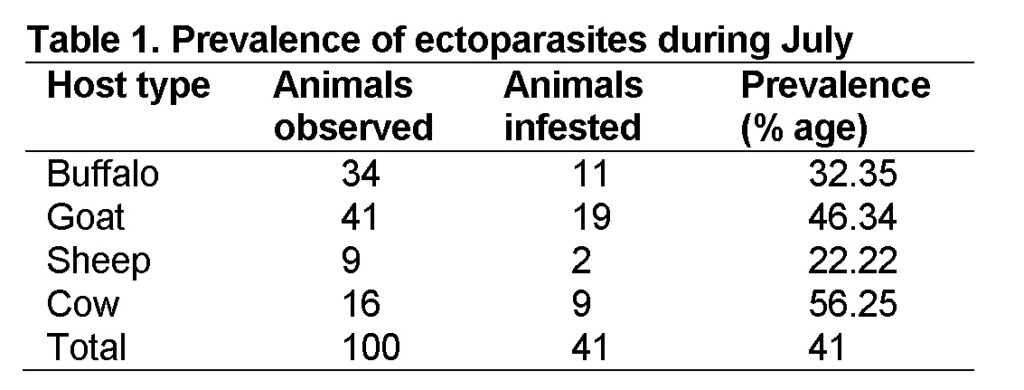
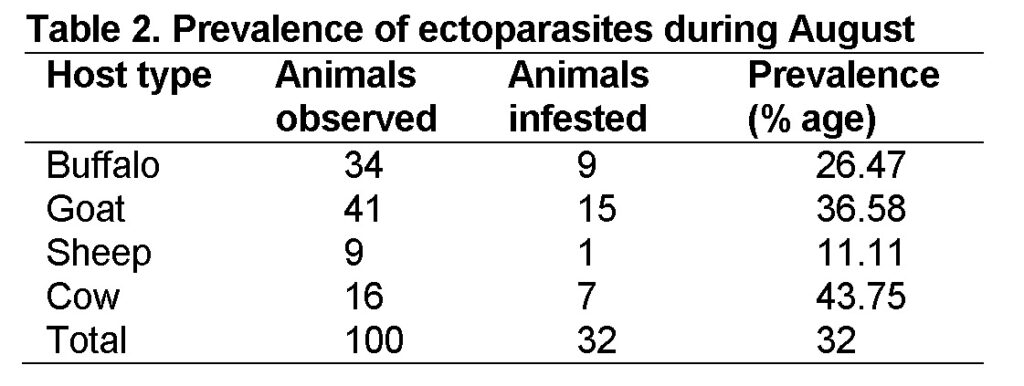
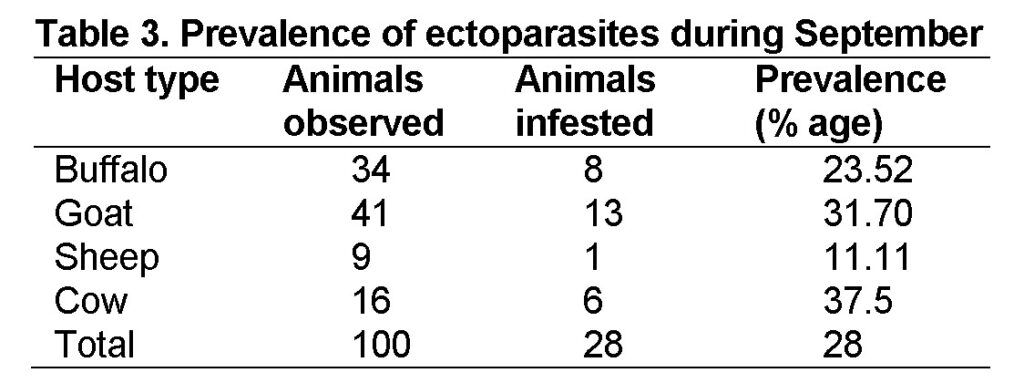
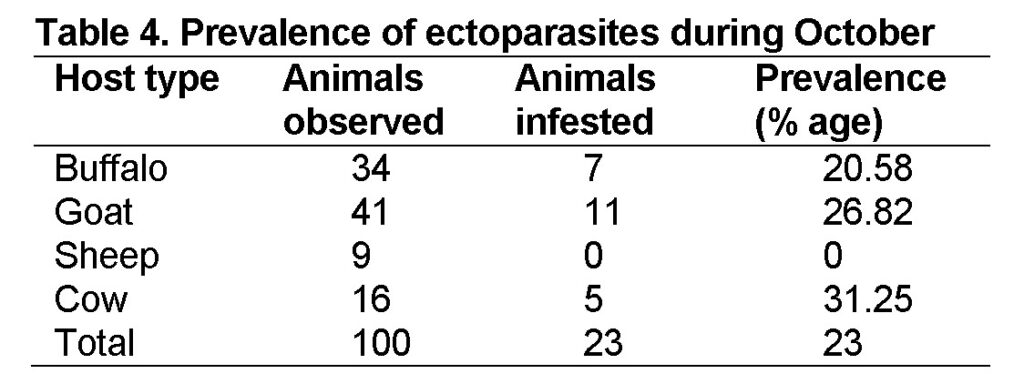
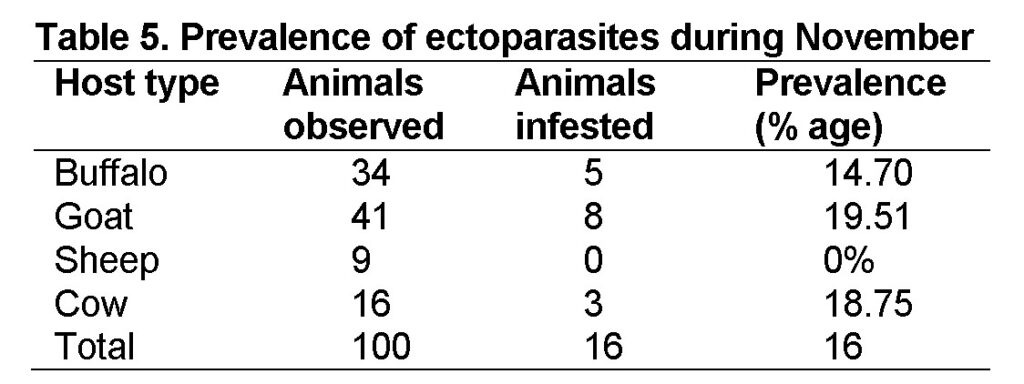
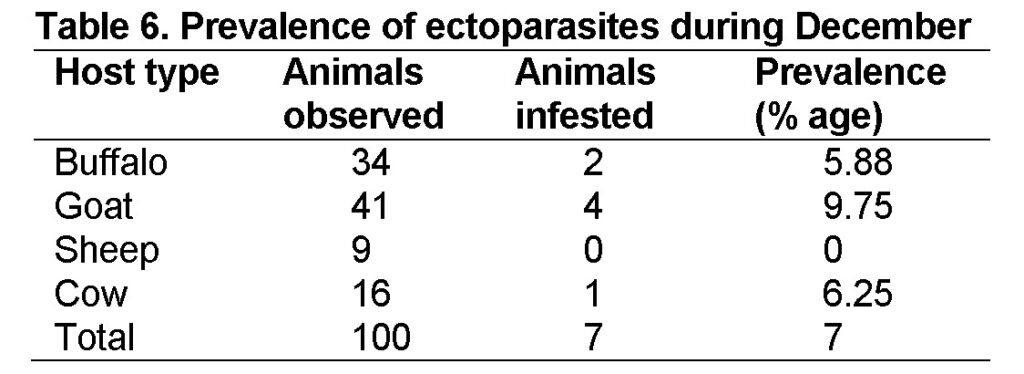
In current study a total of 100 ruminants including 34 buffalo, 41 goat, 9 sheep and 16 cows were randomly selected for ectoparasitic infestation. The seasonal ectoparasite infestation during the study was greater in summer season than winter. The data was summarized in tables 1-6. Monthly highest prevalence of ectoparasites was during July and lowest during December. The highest prevalence recorded in month of July that was 41%. In august prevalence rate was 32%, 28% in September, 23% in October, 16% in November and 7% were recorded in December.
Discussion
The current research work showed extremely extraordinary frequency and widespread occurrence of ectoparasites in ruminant in the study area, and the mostly identified ectoparasites were tick, lice, mange mite and fleas. Conducive environment, malnutrition and feeble animal fitness delay amenities are thought to have donated for prevalent spreading and existences of ectoparasites. Skin in the study area were only used for local purpose but not sold. As Ectoparasites are the foremost foundations of skin downgrading and rejection in tanneries, reduce livestock productivity and vector of various diseases incurring economic losses. Control of ectoparasites needs assimilated ectoparasite administration arrangements that associate hygienic presentation of ectoparasiticides, decrease of propagation locations, ecological weed and foliage control (Radostist et al., 2007). Infected cattle due to ectoparasites become immunocompromised, therefore prone to numerous diseases (viral and bacterial), which might more depreciate the physiological sketch, most important to enormous dynamic disaster. Due to this reason, preventive therapy is necessary for the farming community to diminish attack ratio of ectoparasites (Rhabari et al., 2009). Improved management practice and intervention is required to control parasitic infections (Seyoum et al., 2015). Ectoparasite diseases are more prevalent in young animals than older animals (Geden and Bishop, 1990) due to deficiency of acquired immunity or bad quality feed.
The current study correlates with the earlier study of Mulugeta et al., 2010). Who originate underweight animals are more vulnerable to any infection as they are immune compromised. Moreover, Colwell et al., (2001) also found that in immune compromised animals, prevalence of tick is usually increased. According to the results of the current research work, some lice species were more predominant in younger animals and others in older animals. This may be described on the origin of younger animals, which have low resistance and it rises with the age of the animals and then it reduce with the increasing age of the animal (Nelson et al., 1970). Some of the infections are principally associated with environmental factors (Haines and Patz, 2004) includes, topography, altitude (Joudaet al., 2004), Climate temperature, humidity, rainfall, Season of the particular area. Whereas host related factors including age, sex, breed, nutrition (Springell, 1974). Husbandry and housing practices (BlackWell et al., 2008). Exercised by the farmers, of that area also influence the distribution and abundance of ectoparasite infestation. This was probably the first report which showed the negative result of ectoparasite distribution and infestation in cattle. In study area winter season started from mid- November to March usually but sometime extended to April- May. During this period the temperature falls continuously and reached up to zero °C. Ectoparasites are much vulnerable to environmental influences. The range of this temperature is higher than the temperature of study area elucidated temperature is one of important risk factors associated with the abundance and distribution of ectoparasites in cattle. The current studies calls for special ectoparasite control intercession in the district for valuable production of skin and to upsurge the efficiency of small ruminants.
Conclusion
In this study, prevalence of ectoparasites of ruminant in Tehsil Muzaffarabad district of AJK was studied. Study is essential to determine the economic losses per year from ectoparasitic infestation in ruminant in AJK also in Pakistan. A better understanding of distribution and abundance of ectoparasite infestation on cattle in the study area demanding a complete randomized surveillance study with expanded area, season and large sampling frame to be covered in order to make more reliable justification on ectoparasite abundance and distribution in the area infesting cattle.
Acknowledgement
Authors acknowledge Dr. Ali Muhammad, Assistant Professor, Department of Zoology, University of Poonch, Rawalakot 12350, Azad Kashmir, Pakistan, for kind support during this study.
Conflict of Interest
The authors declare that this article content has no conflict of interest.
References
Agarwal, P., Gupta, A.R., 2010. Management of Ectoparasite of Livestock Department. Dairy Cattle., 23: 89-33.
Beyecha, K., Kumsa, B., Beyene, D., 2014. Ectoparasites of goats in three agro ecologies in central Oromia, Ethiopia. Comp. Clin. Path., 23: 21-28.
Blackwell, E.J., Twell, C., Seawright, A., 2008. The relationship between training methods and the occurrence of behavior problems, as reported by owners, in a population of domestic dogs. J. Vet. Behav. Clin. Appl. Res., 3: 207-217.
Byford, R.L., Criag, M.E., Crossby, B.L., 1992. A review of ectoparasite and their effect on cattle production. J. Anim. Sci., 70: 597-602.
Colwell, D.D., Clymer, B., Booker, C.W., Guichon, P.T., Jim, G.K., Schunicht, O.C., 2001. Prevalence of sucking and chewing lice on cattle entering feedlots in southern Alberta. Can. Vet. J., 42: 281-285.
Drummond, R,O. et al., 1981. Estimated losses of livestock to pests, CRC Handbook of Pest Management in Agriculture, 1: 111-127.
Geden, C.J., Rutz, D.A. and Bishop, D.R. 1990. Cattle Lice (Anoplura,Mallophaga) in New York: Seasonal population changes, effects ofhousing type on infestations of calves, and sampling efficiency. J. Econ. Entom., 83(4): 1435-1438.
Gray, J.S., Dautel, H., Estrada, A., Kahl, O., Lindgren, E., 2009. Effects of climate change on ticks and tick-borne diseases in Europe. Interdis. Pers. Infec. Dis., doi:10.1155/2009/593232.
Haines, A., Patz, J.A., 2004. Health effects of climate change. J. Am. Med. Assoc., 291(1): 99-103.
Holds and Worth, P.A. 2005. Ectoparasiticide use in contemporary Australian livestocks production. Avacre,Canberra Australia., PP: 45-57.
Iqbal, M.N., Muhammad, A., Anjum, A.A., Shahzad, K.A., Ali, M.A., Ali, S., 2014. Epidemiology of Gigantocotyle explanatum in naturally infected buffaloes. Veterinaria., 1(1): 15-18.
Iqbal, M.N., Muhammad, A., Anjum, A.A., Shahzad, K.A., Ali, M.A., Ali, S., 2014. Prevalence of Gastrothylax crumenifer in the gastrointestine of Bubalus bubalis. Veterinaria., 1(1): 28-31.
Iqbal, M.N., Shahzad, K.A., Muhammad, A., 2013. Identification and prevalence of Paraphistomum cervi in naturally infected water buffaloes of central Punjab, Pakistan. Veterinaria., 1(1): 9-12.
Jouda, F., Perret, J.L., Gern, L., 2004. Ixodes ricinus density, and distribution and prevalence of Borrelia burgdorferi sensu lato infection along an altitudinal gradient. J. Med. Entomol., 41(2):162-9.
Kabir M.H.B., Mondal, M.M.H., Eliyas, M., Mannan, M.A., Kashem, M.A., Elahi, M.F., 2011. An epidemiological survey on investigation of ticks infestation in cattle at Chittagon g DistricBangladash. Afr. J. Mic. Res., 5(4): 346-352.
Manan, A.Z. and Ahmed., 2007. Prevalence and Identification of Ixodid Ticks genera in frontier Region peshwar.J. Agri. Bio. Sci., (2): 19-16.
Muhammad, A., Shah, S.I., Iqbal, M.N., Ali, S., Irfan, M., Ahmad, A., Qayyum, M., 2015. Prevalence of Gigantocotyle explanatum in buffaloes slaughtered at Sihala Abattoir, Rawalpindi. Punjab Univ. J. Zool., 30(1): 11-14.
Mulugeta, Y., Yacob H.T., Ashenafi, H., 2010. Ectoparasites of small ruminants in three selected agroecological sites of Tigray Region, Ethiopia.Tropical. Anim. Health Prod., 42: 1219-1224.
Nelson, W.A., Shemanchuk, J.A., Haufe, W.O., 1970. Haematopinus eurysternus: Blood of cattle infested with the short-nosed cattlelouse. Exper. Parasit., 28: 263-271.
Radostits, O.M., Gay, C., Hinchcliff, K.W., Constable, P.D., 2007. A textbook of the diseases of cattle, sheep, goats, pigs and horses, 10th edition, Saunders, Edinburgh, London, pp: 1585-1612.
Rahbari, S., Nabian, S., Bahonar, A.R., 2009. Some observations on sheep sarcoptic mange in Tehran province, Iran. Trop. Anim. Health Prod., 41: 397-401. doi: 10.1007/s11250-008-9203-9.
Seyoum, Z., Tadesse, T., Addisu, A., 2015. Ectoparasites Prevalence in Small Ruminants in and around Sekela, Amhara Regional State, Northwest Ethiopia. J. Vet. Med., http://dx.doi.org/10.1155/2015/216085.
Shaukat, N., Khan, B., Khan, T., Younis, M.N., Faris, N., Javed, A., Iqbal, M.N., 2016. A Comprehensive Review of Biogas Sector for Electric Power Generation in Pakistan. PSM Biol. Res., 01(1): 43-48.
Soulsbly, E.J.L., 1982. Hlmiths , arthropods and protozoa of domesiticated animals.7thed. Bailliere Tindal, London UK.123: 55,88.
Springell, P.H., 1974. The cattle tick in relation to animal production in Australia. Wld. Anim. Rev. (FAO)., (10): 19-23.